Pages

Friday, February 1, 2013

What Are These Foods? (Image & Imagination #4)


What are these?

Hint:
They are all from something edible...

Try looking at common objects in new ways,
in different forms.

Be attentive to odd things just as they appear.


With a silhouette.


Weird already...


Cropped to see just a part...

Or artfully arranged...


How can you use image and imagination in the kitchen?

Try it!

I took all of these pictures, many in the past few days.
The others are from posts on my other blogs, as linked below.

So what are they?

Train your eyes to see -- to be amused and amazed at God's creativity!

Life will be so much more interesting and inspired!

Virginia Knowles
www.ContinueWellHomeSchool.blogspot.com


Thursday, December 27, 2012

"If" by Rudyard Kipling


It's coming up on Rudyard Kipling week in my home school co-op English classroom! (You can read more about his life here: Rudyard Kipling.) We're going to read three of his "Just So Stories" (like "How the Camel Got His Hump") and three of his poems ("If" and "The Thousandth Man" and "L'Envoi").  Some of these pieces can be found in The Book of Virtues, and you can listen to a narration of Just So Stories on-line.  Kipling is perhaps best known for his Jungle Books, later made into a Disney movie.  You can also see an intriguing virtual animation of "If."

Here is my favorite piece by Kipling, which is obviously drawn from this own varied life experiences:

"If"

If you can keep your head when all about you
Are losing theirs and blaming it on you;
If you can trust yourself when all men doubt you,
But make allowance for their doubting too:
If you can wait and not be tired by waiting,
Or, being lied about, don't deal in lies,
Or being hated don't give way to hating,
And yet don't look too good, nor talk too wise;

If you can dream---and not make dreams your master;
If you can think---and not make thoughts your aim,
If you can meet with Triumph and Disaster
And treat those two impostors just the same:.
If you can bear to hear the truth you've spoken
Twisted by knaves to make a trap for fools,
Or watch the things you gave your life to, broken,
And stoop and build 'em up with worn-out tools;

If you can make one heap of all your winnings
And risk it on one turn of pitch-and-toss,
And lose, and start again at your beginnings,
And never breathe a word about your loss:
If you can force your heart and nerve and sinew
To serve your turn long after they are gone,
And so hold on when there is nothing in you
Except the Will which says to them: "Hold on!"

If you can talk with crowds and keep your virtue,
Or walk with Kings---nor lose the common touch,
If neither foes nor loving friends can hurt you,
If all men count with you, but none too much:
If you can fill the unforgiving minute
With sixty seconds' worth of distance run,
Yours is the Earth and everything that's in it,
And---which is more---you'll be a Man, my son! 


Rhythm and Rhyme

Read the poem aloud so you can hear how it sounds. Note the rhythm.  Usually, every other syllable in each line is emphasized.  The lines alternate between 11 and 10 syllables.

This poem has an AB AB CD CD rhyme scheme for each verse.  That means that the following line pairs rhyme: first and third, second and fourth, fifth and seventh, sixth and eighth.  This might be confusing since in the first verse, the first four lines all rhyme with each other, and three of the lines even end in the same word.

Some of the rhymes are two syllables.  In the first verses, the first pair is about you and doubt you and the second pair is waiting and hating.   Find the other pairs of two syllable rhymes in this poem. (Note that some of the words/phrases have three syllables, but only the last two syllables rhyme with the other word/phrase in the rhyming pair.)


The Meaning

This poem talks about many things, but what is the main theme? 

Match the following character qualities with the lines from the poem:

Patience when things are taking too long    _____
Perseverance in times of difficulty  _____
Making the best use of your time  _____
Honesty  _____
Calmness when everyone else is fussing at you   _____
Imagination and vision for the future, along with a dose reality    _____
Healthy self-confidence, with respect for other’s opinions    _____ 
  1. “If you can keep your head when all about you are losing theirs and blaming it on you…”
  2. “If you can trust yourself when all men doubt you, but make allowance for their doubting”
  3. “If you can dream – and not make dreams your master”
  4. “If you can fill the unforgiving minute with sixty seconds worth of distance run”
  5. “If you can wait and not be tired by waiting”
  6. “Or, being lied about, don't deal in lies”
  7. “If you can force your hurt and nerve and sinew to serve your turn… and so hold on”
There are many contrasts in this poem that compare one thing against another, or that clarify what an idea means.  For example, "If you can keep your head when all about you are losing theirs" compares two different kinds of people -- the calm and the unreasonable.  The contrast in the line "If you can dream -- and not make dreams your master" clarifies that imagination and vision for the future are good, as long as they are kept in perspective with reality, and that they are adjusted as necessary.

(Note: Despite the ending "you'll be a Man, my son!" this poem applies equally to both genders!)

Saturday, December 1, 2012

Masterpieces of the Infant Jesus at the National Gallery of Art

An assignment for my 5th-6th grade co-op students...

Look at each of the nine pictures very carefully. You can click on them to enlarge them. The dates listed are approximately when the art was created.  All of the ones in this post are related to the birth of Christ.  The paintings are from the National Gallery of Art in Washington, D.C. (I had to take the pictures from a slight angle because otherwise I was getting a glare from the flash.) These paintings and sculptures were created during the Renaissance. Some of them are gilded. Many of the the titles contain the words madonna and adoration. Click on each of these four bold words and write down definitions.

There are Bible passages linked below three of the paintings.  Read each one.

Writing assignment: Tell which one is your favorite piece of art and why. Then describe this picture or sculpture in at least three sentences.


"The Adoration of the Shepherds"
by Giorgione, 1505-1510
Read Luke 2:1-20 and copy verse 14.

"Adoration of the Shepherds" 
patterned after a piece by Annibale Fontana, 
1600s, Terracotta

"The Adoration of the Magi" by 
Benvenuto di Giovanni in 1470-1475
Read Matthew 12:1-12 and copy verse 11.
"Madonna and Child"
by the Florentine School, 1425

Click here to see another
 Madonna and Child sculpture
at the NGA
.

"Madonna and Child" by 
Circle of Giovanni di Turino 1430, 
painted and gilded terracotta

"Madonna Enthroned with Saints and Angels" 
by Agnolo Gaddi 1380-1390

Read more about this triptych here.
"Madonna and Child"
by Giotto 1320-1330
"The Alba Madonna" by Raphael in 1510 
(St. John the Baptist is the other child 
in this painting.)
Read about this painting at: Alba Madonna.

"The Flight into Egypt"
by Vittore Carpaccio, 1515
Read Matthew 2:13-23.

Saturday, November 24, 2012

Yuletide and Christmas: St. Boniface and "The Holly and the Ivy"

Dear friends,

These links and information are for the students in our home school co-op's 5th-6th grade English class. They are learning about medieval life in their history class, so I am trying to customize some of their literature selections to complement that. This week, at the start of Advent, we are learning how the Druids (pagans who practiced child sacrifice and a lot of superstition) came to accept Christianity, and how their existing winter solstice traditions were adapted to express the glad Christmas tidings of Jesus.

"How St. Boniface Kept Christmas Eve" is from the vintage book American Normal Readers, Book 5.  Print pages 212-227.  This will show up as numbers 207-222 on the book pages.  You can also find "Yuletide Customs" in the same online book.  Print pages 200-202, which will show up as 195-197 on the book pages.

Questions:
  1. In what year did this story take place?  How many years ago was this?
  2. The first paragraph of the story describes the setting. Write two sentences about it.
  3. The story next describes the main character. What is the man wearing?
  4. What virtues is the bishop said to have on the first two pages?
  5. The bishop's birth name was Wilfred, but he has been renamed Boniface by the pope. What does Boniface mean?
  6. What are Boniface's specific goals for ministering in Germany, following the example of Augustine?
  7. What does Boniface plan to do to the sacred Druid oak tree, and why?
  8. What did the Archdruid intend to do with a small child at the oak tree, and why?
  9. What message did Boniface bring to the Druids about Jesus?
  10. What does Boniface do with the wood from the oak tree?
  11. What does Boniface want to do with the Druid traditions of the mistletoe, Yule log and holly?
  12. What kind of tree will now be used to celebrate Christmas?
  13. Find three words in this story which are unfamiliar to you and look them up. What do they mean?

"The Holly and the Ivy"


“The Holly and the Ivy”

The holly and the ivy,
When they are both full grown
Of all the trees that are in the wood
The holly bears the crown
O the rising of the sun
And the running of the deer
The playing of the merry organ
Sweet singing in the choir
.


The holly bears a berry
As red as any blood
And Mary bore sweet Jesus Christ
To do poor sinners good
O the rising of the sun
And the running of the deer
The playing of the merry organ
Sweet singing in the choir
.

The holly bears a blossom
As white as lily flower
And Mary bore sweet Jesus Christ
To be our sweet Saviour
O the rising of the sun
And the running of the deer
The playing of the merry organ
Sweet singing in the choir
.

The holly bears a prickle
As sharp as any thorn;
And Mary bore sweet Jesus Christ
On Christmas Day in the morn.
O the rising of the sun
And the running of the deer
The playing of the merry organ
Sweet singing in the choir
.

The holly bears a bark
As bitter as any gall;
And Mary bore sweet Jesus Christ
For to redeem us all.
O the rising of the sun
And the running of the deer
The playing of the merry organ
Sweet singing in the choir
.

The holly and the ivy
Now both are full well grown,
Of all the trees that are in the wood,
The holly bears the crown.
O the rising of the sun
And the running of the deer
The playing of the merry organ
Sweet singing in the choir
.

Question:

The middle four verses of “The Holly and the Ivy” start with the words “The holly bears a...” What four items are mentioned, and what object is compared to each one? The third line of each of those verses is “And Mary bore sweet Jesus Christ.” The word bore is the past tense form of the word bear. So the author is also comparing the holly to Mary.

We are studying other tales, songs, and poems during Advent.  Stay tuned!

Virginia Knowles
www.ContinueWellHomeSchool.blogspot.com

Monday, October 22, 2012

A Medieval Mish Mash in English Class

Dear friends,

My English class at our home school co-op was a bit of a mish mash today.  My assistant Dawn (who is actually now my co-teacher) presented a grammar lesson on conjunctions and interjections, and then I took over for the rest of the class.  In their history class earlier in the day, my seven students are learning medieval history, with lessons on St. Columba, St. Gregory the Great, and Japan in their assignments this coming week.  I decided to put my laptop computer to use to turn their history lessons into English lessons too.  (I love to integrate the school subjects with related literature!)

For poetry, we read "The Prayer of St. Columba."  The chants and prayers of the early church were passed down from century to century, a potent form of devotional communication.  While reading this prayer, we talked about the use of repetition ("Let me...") and parallelism in the first four stanzas.  We also talked about the historical context (the "isle" is Iona in Scotland) and the vocabulary of monasticism, such as liturgy, chant, and cell.

The Prayer Of St. Columba

Columba crossingLet me bless almighty God,
whose power extends over sea and land,
whose angels watch over all.

Let me study sacred books to calm my soul:
I pray for peace,
kneeling at heaven's gates.

Let me do my daily work,
gathering seaweed, catching fish,
giving food to the poor.

Let me say my daily prayers,
sometimes chanting, sometimes quiet,
always thanking God.

Delightful it is to live
on a peaceful isle, in a quiet cell,
serving the King of kings.


Next, speaking of chants, St. Gregory, who was a reluctant pope (preferring the simple life of a monk), is most known for the chants named after him.  We listened to a short one.


Gregorian Chants:


Then, more poetry, this time Japanese style!  I explained the basic structure of haiku -- first line 5 syllables, second line 7 syllables, third line 5 syllables -- and that it is usually about a nature theme and uses a word that reveals the season.  This was not an in-depth lesson.  Maybe next week we will actually try writing some.  I just wanted them to get a taste of it to whet their appetites.  Here is one web page that helped me: http://examples.yourdictionary.com/examples-of-haiku-poems.html


Next up, since Dawn had made a passing reference to Schoolhouse Rock's song about Interjections in her grammar lesson, I found it via a quick Google search.  Hilarious!  Takes me back to childhood educational TV!  (The series started airing in 1973 when I was 9 or 10.  Now that's medieval!)

Schoolhouse Rock Interjections


Many Luscious Lollipops
More on grammar... I had wanted to read a book called Many Luscious Lollipops: A Book About Adjectives last week when they were studying... adjectives!  I ran out of time then, but was able to tuck it in today. 

"It never fails to add details to what you write or say... a MESMERIZING, COLORFUL, and GLITTERING display."


Last but not least, our very favorite part of the class is when my students get to read some of their creative writing assignments.  Last week's assignment, launching off the legend of King Arthur's birth, was to write about something special or interesting about their own birth or early childhood.  This involved interviewing their parents.  One of the girls wrote a hilariously true tale about sneaking out of her crib in the middle of the night at the tender age of 18 months, raiding the refrigerator, and painting her sleeping mother's back with sour cream.  Never a dull moment in English class!

If we'd had more time, we would have reviewed our lessons on The Lion, the Witch and the Wardrobe, our current literature selection.  We'll get back to that next week. See: The Lion, the Witch and the Wardrobe Study Guide, Part 1.

Virginia Knowles

www.ContinueWellHomeSchool.blogspot.com


Wednesday, September 19, 2012

Masterpieces from the Bible (Image & Imagination #2)

Last week I started a new blog series, Image & Imagination, to explore how to stimulate our children's curiosity with pictures. 

I like to integrate fine art and Biblical themes when I teach, whether it is in my own home or in our home school co-op English or history classes.

Our 5th and 6th graders have been studying the early church in history class and reading through the book of Acts in English class.  In class this week, I showed them several pieces from the huge volume of Great Bible Stories and Master Paintings by Owen S. Rachleff, which was a gift from my late father-in-law in our early home schooling years.  I wish we had more time to take a long look at them!  Maybe next week...  You can look up these paintings on-line, keeping in mind that there are variations in titles.  I have linked some of them here:


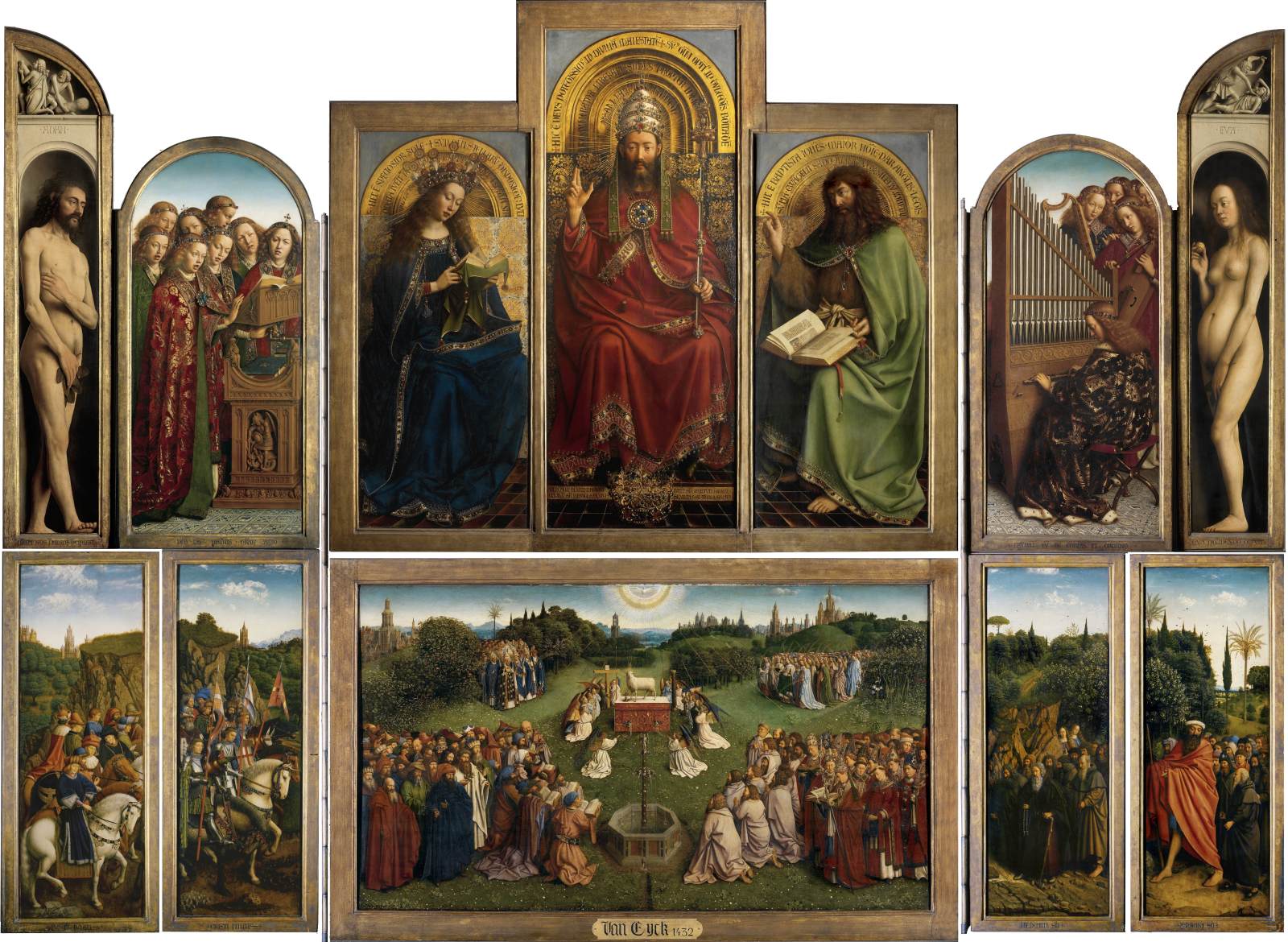
Another masterpiece that I've been enjoying lately is "The Adoration of the Lamb of God" by Flemish painter Jan Van Eyck.  This picture has graced the front of our church bulletin every week in this liturgical season after Pentecost.  I wonder what painting will come next?


The painting you see above is not even the full piece of art.  It is a portion of the lower center panel in a polyptych (multi-panel) piece.


You can find wonderful commentaries on masterpiece paintings on-line.  Here are two which are particularly helpful for this piece:


For example, within its lengthy description, the latter of these sites notes, "Thus the central panel of the lower tier portrays the saints symbolizing the eight Beatitudes gathered round the altar where the sacrifice of the Lamb is taking place, at the centre of the heavenly garden which has sprung from His blood."


I encourage you to look at the sites I linked and study this painting and others. On my class blog in previous years, I posted several lessons which include a lot of Biblical art along with associated writing and literature assignments. 

Virginia Knowles

www.ContinueWellHomeSchool.blogspot.com

Tuesday, September 18, 2012

The Apostles' Creed


The Apostles' Creed


I believe in God the Father, Almighty, Maker of heaven and earth:
And in Jesus Christ, his only begotten Son, our Lord:
Who was conceived by the Holy Ghost, born of the Virgin Mary:
Suffered under Pontius Pilate; was crucified, dead and buried:
He descended into hell:
The third day he rose again from the dead:
He ascended into heaven, and sits at the right hand of God the Father Almighty:
From thence he shall come to judge the quick and the dead:
I believe in the Holy Ghost:
I believe in the holy catholic church: the communion of saints:
The forgiveness of sins:
The resurrection of the body:
And the life everlasting. Amen.

Vocabulary:
  • begotten - born
  • descended – went down
  • ascended – went up
  • thence – there
  • quick – living
  • Holy Ghost – Holy Spirit
  • catholic – universal or whole (not the same thing as the Roman Catholic church)
  • communion – fellowship
  • saints – believers in Jesus, all Christians
  • everlasting – lasting forever, eternal
  • trinity – three-in-one (This word is not in the creed, but the three persons in the one God are listed: Father, Son, and Holy Ghost. I have underlined them in the text.)

The first line in Latin and English:

Credo in Deum Patrem omnipotentem; Creatorem coeli et terrae.
I believe in God the Father Almighty creator of heaven and earth.

In our home school co-op, the 5th-6th graders are using Mystery of History Volume 2 in their history class.  As their English teacher, I am trying to coordinate my assignments with what they are doing in history.  This week I noticed they are learning about The Apostles' Creed, so I decided to go over some of the unfamiliar words.  They will be reciting and copying the creed this week for homework.  Optionally, they may illustrate it and/or make it look like an old scroll.

Here are two helpful links to learn more about the history and significance of the Apostles' Creed, the most widely used statement of belief in the western church: 

Related Posts with Thumbnails