A
couple of days ago, I wrote a post on www.startwellhomeschool.blogspot.com about What
We're Doing for Elementary School This Year.
We're also home schooling two middle school students: a son in 8th grade and a daughter in 6th grade. My son has
always been home schooled, while my daughter attended a public
elementary school for the last four months of the last school year.
Our
family is continuing with the home school co-op that we've been in
for several years with the exception of one year we just home
schooled - at home.
Here is a run down of what we're doing in and out of co-op.
Here is a run down of what we're doing in and out of co-op.
My
daughter is taking 6th grade math, with only one other student in her
class. They are using the McDougal Littell text, along with a student notebook volume.
For science and history, she is in mixed level classes with 4th-6th grade students.
For science and history, she is in mixed level classes with 4th-6th grade students.
 The
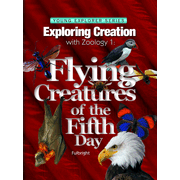
science class is using the Apologia text about flying creatures,
which is mainly birds and insects but includes bats and other
airborne creatures as well. They are doing lots of hands-on activities and creating a Charlotte Mason style notebook of all they are learning.
The
science class is using the Apologia text about flying creatures,
which is mainly birds and insects but includes bats and other
airborne creatures as well. They are doing lots of hands-on activities and creating a Charlotte Mason style notebook of all they are learning.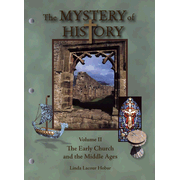 The
history class is using Mystery of History Volume 2 by Linda Hobar.
It covers the time period from the early church up through the Middle
Ages. Each day they read a lesson, make note cards with the
important facts, do an activity (such as mapping or a short report) and add a figure to their time line.
The
history class is using Mystery of History Volume 2 by Linda Hobar.
It covers the time period from the early church up through the Middle
Ages. Each day they read a lesson, make note cards with the
important facts, do an activity (such as mapping or a short report) and add a figure to their time line.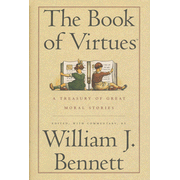 I
teach my daughter's English class, which is 5th-6th
grades. I chose to integrate the literature and writing assignments
with their history topics, so if they are studying about Genghis Khan
in history, we'll read a legend about him for English. The easiest way to
accomplish this is to use The Book of Virtues as our
main literature resource.
I
teach my daughter's English class, which is 5th-6th
grades. I chose to integrate the literature and writing assignments
with their history topics, so if they are studying about Genghis Khan
in history, we'll read a legend about him for English. The easiest way to
accomplish this is to use The Book of Virtues as our
main literature resource.  We are also reading through the book of
Acts in the Bible and C.S. Lewis's The Lion, The Witch and theWardrobe. I have been writing my own study guide for that. For the last class, I brought in some Turkish Delight candy since Edmund eats this while being lured by the evil White Witch in the third chapter.
The first two chapters featured the Professor's huge
country mansion and the Faun's small cave, so I assigned the following
for creative writing: “Imagine that you could design a dream house
that reflects your own interests. It can be as large or as small as
you want. Where will it be? What will it look like on the outside?
Describe each room in your house. What will they be used for? What
will they contain? Draw a floor plan if you would like.” and
“Yesterday you wrote about a
big house you would like to live in. Today, you are going to write
about a small one. If you had an entire home to live in by yourself
that was as small as Tumnus's cave room, what would it be like? Make
a list of what would you need to live in your home and a few extra
things that you would want. What are some practical ways you could
“make do” in such a small space?” I know my students (6 girls
and 1 boy) enjoying this project immensely and we had a lot of fun when they read their house descriptions in class. I mentioned that they might want to
download the free version of the Sketchup 3-D drawing program to design their
houses, and some of them have been doing that, too. In the spring, we will also read the book The Door in the Wall by Marguerite DeAngeli. Usually I would assign more novels, but since we have a lot of stories from The Book of Virtues and the co-op leaders asked me to focus more on writing this year (a current need), I limited it to just those two.
We are also reading through the book of
Acts in the Bible and C.S. Lewis's The Lion, The Witch and theWardrobe. I have been writing my own study guide for that. For the last class, I brought in some Turkish Delight candy since Edmund eats this while being lured by the evil White Witch in the third chapter.
The first two chapters featured the Professor's huge
country mansion and the Faun's small cave, so I assigned the following
for creative writing: “Imagine that you could design a dream house
that reflects your own interests. It can be as large or as small as
you want. Where will it be? What will it look like on the outside?
Describe each room in your house. What will they be used for? What
will they contain? Draw a floor plan if you would like.” and
“Yesterday you wrote about a
big house you would like to live in. Today, you are going to write
about a small one. If you had an entire home to live in by yourself
that was as small as Tumnus's cave room, what would it be like? Make
a list of what would you need to live in your home and a few extra
things that you would want. What are some practical ways you could
“make do” in such a small space?” I know my students (6 girls
and 1 boy) enjoying this project immensely and we had a lot of fun when they read their house descriptions in class. I mentioned that they might want to
download the free version of the Sketchup 3-D drawing program to design their
houses, and some of them have been doing that, too. In the spring, we will also read the book The Door in the Wall by Marguerite DeAngeli. Usually I would assign more novels, but since we have a lot of stories from The Book of Virtues and the co-op leaders asked me to focus more on writing this year (a current need), I limited it to just those two.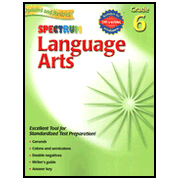
 Besides the
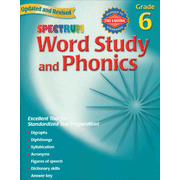
reading and writing, they are also doing two workbooks from Spectrum:
Language Arts 6 and Word Study and Phonics 6. My classroom assistant, another mom in our co-op, has been helping a lot with the grammar lessons in the Language Arts workbook. She is very enthusiastic about this, and has even set some grammar facts, such as the list of indefinite pronouns, to hymn tunes. Speaking of that, we're also going to try to tuck in a little music sight reading skills along the way. Singing is a form of communication, isn't it?
Besides the
reading and writing, they are also doing two workbooks from Spectrum:
Language Arts 6 and Word Study and Phonics 6. My classroom assistant, another mom in our co-op, has been helping a lot with the grammar lessons in the Language Arts workbook. She is very enthusiastic about this, and has even set some grammar facts, such as the list of indefinite pronouns, to hymn tunes. Speaking of that, we're also going to try to tuck in a little music sight reading skills along the way. Singing is a form of communication, isn't it?In addition to her co-op classes, my daughter is doing some reading on her own. One of her older sisters convinced her to start Little Women by Louisa May Alcott, which has been a good pick for her.
 My
8th grade son is using the McDougal Littell
Pre-Algebra text for math. For history, he and the other
7th-8th graders are doing A Beka America, Land I
Love. Like many of the other 8th graders in
co-op, he is taking Apologia Biology for high school credit, since
that follows last year's General Science course pretty nicely. His
English class is using the BJU Press Writing &
Grammar workbook, as well as a variety of
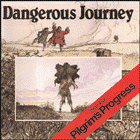
literature. Their first book is The Dangerous Journey,
an adaptation of Pilgrim's Progress. They will also be reading
The Witch of Blackbird Pond, The Light In The Forest, Sounder, and From the Mixed-up Files of Mrs. Basil E. Frankweiler.
My
8th grade son is using the McDougal Littell
Pre-Algebra text for math. For history, he and the other
7th-8th graders are doing A Beka America, Land I
Love. Like many of the other 8th graders in
co-op, he is taking Apologia Biology for high school credit, since
that follows last year's General Science course pretty nicely. His
English class is using the BJU Press Writing &
Grammar workbook, as well as a variety of
literature. Their first book is The Dangerous Journey,
an adaptation of Pilgrim's Progress. They will also be reading
The Witch of Blackbird Pond, The Light In The Forest, Sounder, and From the Mixed-up Files of Mrs. Basil E. Frankweiler.
My
husband is responsible for helping my son with his math and science,
as well as grading assignments for both of those classes. I am very
grateful. He does this for our high school son's math and science,
too.
 In
addition to his co-op classes, my son likes to draw, take pictures of
nature (especially birds, especially after taking the same Apologia
flying creatures class this his sister is in now), make videos, and
read a wide variety of non-fiction. My sister sent a big box of
books this week and he immediately claimed a biography of Thomas
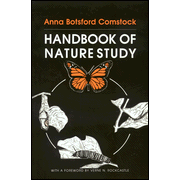
Edison, a drawing book, and Anna Botsford Comstock's massive Handbook of
Nature Study, which was orginally published a century ago.
In
addition to his co-op classes, my son likes to draw, take pictures of
nature (especially birds, especially after taking the same Apologia
flying creatures class this his sister is in now), make videos, and
read a wide variety of non-fiction. My sister sent a big box of
books this week and he immediately claimed a biography of Thomas
Edison, a drawing book, and Anna Botsford Comstock's massive Handbook of
Nature Study, which was orginally published a century ago.Our family also has a Fun Pass to Sea World, thanks to help from my mom. If you pay for a single day ticket, they give you the rest of the year free! That's a lot of marine science field trips.
So that's what we're doing for middle school this year!
Virginia
Knowles


