Pages

Showing posts with label Curriculum. Show all posts

Sunday, September 14, 2014

Add a Little Adventure to Your Home School


Add a Little Adventure
to Your Home School

Life isn't just a matter of fun and games, but a spoonful of sugar sure can help the medicine go down. We can help our children actually enjoy the process of doing their work rather than just tolerating it. In the process, they will learn their own lifetime techniques for making tasks interesting. 

Middle school kids are naturally inquisitive. This creates big demands as Mom and Dad are barraged with “how” and “why” questions at inopportune moments. Within reason, we should not squelch curiosity, but catapult it into self-motivated learning situations.  Here are some ways to enliven academic pursuits:

Hobbies: Hobbies can provide beautiful balance to a home education program. They offer brain-enriching opportunities to plan projects, select materials, follow patterns and instructions, develop skills, care for equipment and supplies, make useful items, and nurture creativity. You could spend tons of money on this (“I want a pony!”) but many activities are free or cheap. 

Imagination: Encourage your children to use their imaginations to ask “what if?”  Let them dream about what they would do with a million dollars or what new technology they want to invent. Even middle school kids can enjoy a well-stocked dress up box for making up their own skits and shooting videos.

Interests: Plan some of their school lessons around their own interests. At the beginning of one school year, I let each of my children choose one independent unit study topic to do for three weeks. One daughter chose dogs because she was passionate about them, even though we haven’t ever had one. She became a virtual “walking encyclopedia” about various breeds. She knew how big they are and the countries from which they originated. She constantly checked out library books about dogs, including titles on how to draw them. Her walls were covered with her sketches, original stories and collages of magazine pictures. For her birthday, I found the Dogs and Puppies Complete Identifier guide book featuring more than 170 breeds in full color photographs. As you can see, from this one interest, she learned reference skills, geography, math, literature, art, creative writing and alphabetization -- and she didn’t even know she was doing school work!   Later, she switched to other interests like music and British literature.

Literature: Include adventure stories in their literature selections, especially as they relate to a unit study. When we studied Australia, we read the first three books of Robert Elmer’s Adventures Down Under series, set in the 1800s. It didn't even seem like school time.

Seasons and themes: Plan art projects, literature, field trips, music, and cooking to enhance holidays, seasons and unit studies.  For example, at Christmastime you can plan an Advent Adventure unit by singing carols, baking cookies, making presents, and reading favorite Christmas poems and stories. For St. Patrick's Day, make green foods to eat, and read about the real St. Patrick.

Bookmaking and displays:  Let your children make an illustrated book or display to creatively summarize what they have learned about a topic. For tabletop projects, we might use three panel folding display board.

Creativity box: Fill an odds-and-ends box with spools, straws, craft sticks, cord, clothes pins, toilet paper tubes and other items for kids to make things of their own. Collect old small appliances for your young tinkerers to dismantle.     

Nature study: Go on nature walks and collect specimens to identify and observe. Are there any nature trails in your county? One of my sons, by age 11, was a nature lover and a talented photographer. He combined these two passions by taking pictures of birds and plants, then editing them on the computer and uploading them to his nature blog. He also recorded bird songs with our video camera. He extended this to academic studies by doing research on birds and their habitats, as well as making detailed pencil sketches. We equipped him by providing several high quality bird guides, including ones that have an audio component that plays bird calls for each page. The best thing we can do is give him plenty of time for this hobby!  This is a huge part of his science studies.

Field trips: Visit local sites such as a history museum, art museum, science center, wildlife refuge, botanical garden,  community theater, beach, etc. If you will be visiting a location often enough, consider getting an annual pass.

Clubs and Classes: Check out art and music instruction, social clubs, hobby clubs, drama groups, choruses, and other group opportunities.

Science experiments: Check out books from your library to find activities which are educational, entertaining, and fairly uncomplicated. Keep basic science exploration supplies on hand, such as magnifying glasses, magnets, and test tubes.

Gardening: Let them plant a garden. If you are a novice or have a black thumb, try buying mature plants instead of growing from seed.  This is also a time to build relationships with neighbors; if you see someone working outside and they have a great garden, ask for advice!  People are usually thrilled to share their expertise.

Pets: Get a class pet. Think through this decision carefully. With most pets, your commitment runs at least a few years. If your pet is unfriendly, your child may resent caring for it. If you choose a nocturnal animal such as a hamster, it might make noise at night and sleep through the day!  You can also choose temporary pets. Our kids keep a terrarium on the back porch ready to house lizards, frogs and other small critters they catch in the yard. They might keep them for a few hours or a few days and then let them go. I like this kind of pet best of all!  Our kids also loved keeping fish. They started out with small aquariums, learning a lot about different kinds and the care they need, and eventually worked up to a 50 gallon aquarium with convict cichlid fish in it. Some of the cichlids had hundreds of babies, which was especially fascinating to watch.

Games, puzzles and crafts: Try strategy and word games such as chess, Pente, Rummikub, Boggle, Scrabble, Twenty Questions, Concentration, etc. Let your child keep score to sharpen math skills, especially in Scrabble, where there is doubling and tripling. Find related games, puzzles, and crafts to supplement regular lessons. Teacher’s manuals and web sites sometimes include ideas for these, but you and your children can make up some of your own.

Group festivities: Participate in your support group’s science fair, history day, international festival, fine arts show, or other opportunities. If they don’t already offer these activities, why not volunteer to do it this year?

Tuesday, August 28, 2012

What We're Doing for Middle School This Year

Dear friends,

A couple of days ago, I wrote a post on www.startwellhomeschool.blogspot.com about What We're Doing for Elementary School This Year.  We're also home schooling two middle school students: a son in 8th grade and a daughter in 6th grade.  My son has always been home schooled, while my daughter attended a public elementary school for the last four months of the last school year.

Our family is continuing with the home school co-op that we've been in for several years with the exception of one year we just home schooled - at home.

Here is a run down of what we're doing in and out of co-op.

My daughter is taking 6th grade math, with only one other student in her class. They are using the McDougal Littell text, along with a student notebook volume. 


For science and history, she is in mixed level classes with 4th-6th grade students.  

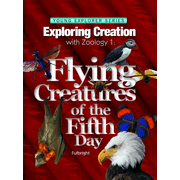
Flying Creatures of the Fifth Day: Exploring Creation with Zoology 1  -     
        By: Jeannie Fulbright
    
The science class is using the Apologia text about flying creatures, which is mainly birds and insects but includes bats and other airborne creatures as well.  They are doing lots of hands-on activities and creating a Charlotte Mason style notebook of all they are learning.


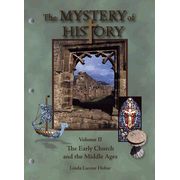
The Mystery Of History, Volume 2: The Early Church and  the Middle Ages  -     
        By: Linda Lacour Hobar
    
The history class is using Mystery of History Volume 2 by Linda Hobar. It covers the time period from the early church up through the Middle Ages. Each day they read a lesson, make note cards with the important facts, do an activity (such as mapping or a short report) and add a figure to their time line.


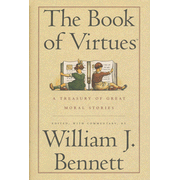
The Book of Virtues   -     
        By: William J. Bennett
    
I teach my daughter's English class, which is 5th-6th grades. I chose to integrate the literature and writing assignments with their history topics, so if they are studying about Genghis Khan in history, we'll read a legend about him for English. The easiest way to accomplish this is to use The Book of Virtues as our main literature resource. 


We are also reading through the book of Acts in the Bible and C.S. Lewis's The Lion, The Witch and theWardrobe. I have been writing my own study guide for that.  For the last class, I brought in some Turkish Delight candy since Edmund eats this while being lured by the evil White Witch in the third chapter.  The first two chapters featured the Professor's huge country mansion and the Faun's small cave, so I assigned the following for creative writing: “Imagine that you could design a dream house that reflects your own interests. It can be as large or as small as you want. Where will it be? What will it look like on the outside? Describe each room in your house. What will they be used for? What will they contain? Draw a floor plan if you would like.” and “Yesterday you wrote about a big house you would like to live in. Today, you are going to write about a small one. If you had an entire home to live in by yourself that was as small as Tumnus's cave room, what would it be like? Make a list of what would you need to live in your home and a few extra things that you would want. What are some practical ways you could “make do” in such a small space?” I know my students (6 girls and 1 boy) enjoying this project immensely and we had a lot of fun when they read their house descriptions in class. I mentioned that they might want to download the free version of the Sketchup 3-D drawing program to design their houses, and some of them have been doing that, too.  In the spring, we will also read the book The Door in the Wall by Marguerite DeAngeliUsually I would assign more novels, but since we have a lot of stories from The Book of Virtues and the co-op leaders asked me to focus more on writing this year (a current need), I limited it to just those two.

 
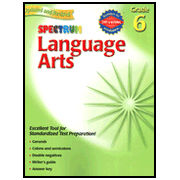
Spectrum Language Arts, 2007 Edition, Grade 6   - Spectrum Phonics, 2007 Edition, Grade 6   - Besides the reading and writing, they are also doing two workbooks from Spectrum: Language Arts 6 and Word Study and Phonics 6.  My classroom assistant, another mom in our co-op, has been helping a lot with the grammar lessons in the Language Arts workbook.  She is very enthusiastic about this, and has even set some grammar facts, such as the list of indefinite pronouns, to hymn tunes.  Speaking of that, we're also going to try to tuck in a little music sight reading skills along the way. Singing is a form of communication, isn't it?


In addition to her co-op classes, my daughter is doing some reading on her own. One of her older sisters convinced her to start Little Women by Louisa May Alcott, which has been a good pick for her.

Dangerous JourneyMy 8th grade son is using the McDougal Littell Pre-Algebra text for math. For history, he and the other 7th-8th graders are doing A Beka America, Land I Love. Like many of the other 8th graders in co-op, he is taking Apologia Biology for high school credit, since that follows last year's General Science course pretty nicely. His English class is using the BJU Press Writing & Grammar workbook, as well as a variety of literature. Their first book is The Dangerous Journey, an adaptation of Pilgrim's Progress. They will also be reading The Witch of Blackbird Pond, The Light In The Forest, Sounder, and From the Mixed-up Files of Mrs. Basil E. Frankweiler.

 
My husband is responsible for helping my son with his math and science, as well as grading assignments for both of those classes. I am very grateful. He does this for our high school son's math and science, too.

Handbook of Nature Study   -     
        By: Anna Botsford Comstock
    
In addition to his co-op classes, my son likes to draw, take pictures of nature (especially birds, especially after taking the same Apologia flying creatures class this his sister is in now), make videos, and read a wide variety of non-fiction. My sister sent a big box of books this week and he immediately claimed a biography of Thomas Edison, a drawing book, and Anna Botsford Comstock's massive Handbook of Nature Study, which was orginally published a century ago.

Our family also has a Fun Pass to Sea World, thanks to help from my mom.  If you pay for a single day ticket, they give you the rest of the year free!  That's a lot of marine science field trips.


So that's what we're doing for middle school this year!

Virginia Knowles


Thursday, November 11, 2010

Twiddling Your Curriculum Choices: Small Changes Can Make a Big Impact

Dear friends,

Have you ever started out using one curriculum and then realized it wasn't working for you or your child?  What do you do next?  This has happened to me many times in the past two decades of home schooling.   Sometimes, I see what I can do to adjust the curriculum so we can keep using it, picking and choosing from it what is helpful and what is not.  Other times I switch to another resource to use at least for a while.  Much of home schooling is a matter of trial and error since each child can be so different from the others, and some curriculum just doesn't click!  Also, there are times when we buy something that we haven't used before and we don't know yet how it will perform in the daily scheme of things.

For about four years, our family was enrolled in a structured home school co-op where each teacher selected the curriculum that would be used by his or her students.  This was, of course, necessary to keep things in order so everyone could be "on the same page" and make it easier for the teacher to plan assignments.  However, I have always loved picking curriculum, so this was one trade-off I had to make.

However, this past spring, having decided we would go back to what my husband calls "true home schooling", I relished the opportunity to go resource hunting again.   There is a wonderful used bookstore near us that carries a lot of curriculum, and I noticed some middle school Earth Science books from a Christian publisher on clearance for $6 a piece.  I bought two identical ones, because the child who would be using them likes to read to me, and it's easier for me, as a visual learner, to follow along if I have my own copy right in front of me.  Well, we used this text for about 12 weeks, but it seemed like he was having a hard time motivating himself to read the chapters, and hunting down the specific answers to the questions always slowed the process down even more.  I asked him about this, and he said he really wanted to learn about a whole variety of science topics, especially physical science, chemistry, technology, etc.

I didn't want to buy anything new for him right then, so I started looking on my shelves for what we already had.  I hit the jackpot with a science encyclopedia (published by Dempsey Parr) which was written for his age level.  Each page spread covers a different topic, with plenty of visually appealing diagrams, charts, and photos.  There are also experiments in the back of the book.  I showed it to him and he was absolutely delighted.  Each day he reads four pages and then writes a paragraph about what he has read.  He prefers this kind of open-ended written narration rather than comprehension questions anyway, so this is perfect.  I love reading what he has learned each day.  Science has become a joy for him instead of drudgery!

One small change, one big impact!  I'm not saying we should be wishy-washy or give in to every sign of discontent in our children, but we do need to give it careful thought and see what we can do.

Don't be afraid to adjust curriculum as needed.  It is not a sign that you "failed" in picking something out the first time, but of sensitivity to your child in being willing to change!  It gives your child the message that you care. 

Oh, what happened to the two Earth Science books I had bought?  I brought them in to sell back to the used bookstore, and oddly enough, the on-line resale price had shot up to $60 each.  The store pays about 50% of expected sales price if you choose to take store credit, so I came out with $30 in credit for each $6 I had spent!  Sweet deal!

Blessings,
Virginia Knowles
http://www.continuewellhomeschool.blogspot.com/

Thursday, November 19, 2009

Medieval Legends and King Robert Bruce

Dear friends,

In my 7th-8th grade English class in our Providence Home Educators co-op, we've been doing a unit on Medieval Legends.  I've been sending home handouts with the legends in them, as well as comprehension questions and related writing assignments.  The two main source books I've been using are:
I also pulled my vintage copy of Hero Tales from History (which belonged to my grandfather when he was a boy in the 1920's) off the shelf for the story of Alfred, the Saxon King.  Then I found an on-line version of my childhood favorite, "Robert Bruce and the Spider" which I will link a little later in this post.  I can't copy the book versions of these stories into my blog post, but I did find on-line versions of many of the stories written at a slightly lower reading level.

KING ALFRED AND THE CAKES by James Baldwin
KING ALFRED AND THE BEGGAR by James Baldwin
BRUCE AND THE SPIDER by James Baldwin
THE KING AND HIS HAWK by James Baldwin

 
LITERATURE STUDY OF ROBERT BRUCE AND THE SPIDER

Robert Bruce was a king of Scotland who lived from 1274-1329.   Here is the tartan pattern of the Bruce clan.


Click the link to read the story (preferably print it out) and the poem. I have provided study questions below.  Choose several words to underline in the story to use as vocabulary words. You will find the first page of the story (with a link for the second page) at: http://www.longlongtimeago.com/llta_history_bruce_page02.html

Story Questions


  1. In which century did this story take place?
  2. What is the first setting of the story? Where does the story end?
  3. List the three words in the first paragraph that let you know it is cold.
  4. Note that the story was written in British style. The quotes are single (') instead of double (") and there is one word in the first paragraph that uses British spelling. What is it? How do we Americans spell this word?
  5. Write down the words that your parent has underlined in the story. Look up the definitions and write them in your own words.
  6. Underline all of the adjectives in the story. Notice that they are generally vivid and descriptive, adding interest to the story.
  7. List at least four words used to show the king's emotions.
  8. Why was Robert in agony?
  9. How long after seeing the spider did he still need to persevere in order to gain the final victory?
  10. What is the lesson of this story? Write at least three sentences.

Writing or Oral Narration Assignments:
  1. Write a one paragraph summary of the story using vivid verbs and quality adjectives. Use a variety of sentence structures.
  2. Tell of a time when you hesitated to do something.  What helped you overcome this?  What was the result?
  3. Read more about Robert Bruce at www.longlongtimeago.com/llta_history_bruce.html (or for more advanced readers or parents who want to paraphrase www.britannia.com/bios/robertbruce.html) or other sources.  Write a paragraph about what you learn.
POETRY
 

"Bruce and the Spider"
Bernard Barton (1784-1849)

 
For Scotland's and for freedom's right
The Bruce his part has played;--
In five successive fields of fight
Been conquered and dismayed:
Once more against the English host
His band he led, and once more lost
The meed for which he fought;
And now from battle, faint and worn,
The homeless fugitive, forlorn,
A hut's lone shelter sought.

 
And cheerless was that resting-place
For him who claimed a throne;--
His canopy, devoid of grace,
The rude, rough beams alone;
The heather couch his only bed--
Yet well I ween had slumber fled
From couch of eider down!
Through darksome night till dawn of day,
Absorbed in wakeful thought he lay
Of Scotland and her crown.

 
The sun rose brightly, and its gleam
Fell on that hapless bed,
And tinged with light each shapeless beam
Which roofed the lowly shed;
When, looking up with wistful eye,
The Bruce beheld a spider try
His filmy thread to fling
From beam to beam of that rude cot--
And well the insect's toilsome lot
Taught Scotland's future king.

 
Six times the gossamery thread
The wary spider threw;--
In vain the filmy line was sped,
For powerless or untrue
Each aim appeared, and back recoiled
The patient insect, six times foiled,
And yet unconquered still;
And soon the Bruce, with eager eye,
Saw him prepare once more to try
His courage, strength, and skill.

 
One effort more, his seventh and last!--
The hero hailed the sign!--
And on the wished-for beam hung fast
That slender silken line!
Slight as it was, his spirit caught
The more than omen; for his thought
The lesson well could trace,
Which even "he who runs may read,"
That Perseverance gains its meed,
And Patience wins the race.

 
Poetry Questions:  
  1. Read the poem aloud.  Can you determine the rhythm pattern?  Which syllables are emphasized?  How many syllables are in each line? Is there a pattern of the number of syllables in each line of all of the stanzas? Note: In some cases, two syllables may be compressed into one to keep the rhythm. An example of this is the word "seventh" in the first line of the last stanza.
  2. Notice which pairs of lines in each stanza rhyme. Assign each rhyme pair a letter. What is the rhyming pattern of the poem? Hint: each stanza has the same basic pattern, though with different rhymes.  Note: sometimes the rhymes are not exact, like "host" and "lost" in the first stanza.  These are more visual than audible rhymes.
  3. An archaic word is one that is obsolete, and is not used anymore. "Meed" is an archaic word that means "reward." Find the two places it occurs in the poem, and circle them.   What other archaic words do you see in this poem?
  4. In what ways is the poem different than the story?

(Note to parents: The rhythm pattern of the poem is dee DUM dee DUM dee DUM, etc. with even numbered syllables emphasized.  The pattern of the number of syllables in the lines of each stanze is roughly 8-6-8-6-8-8-6-8-6-6-8.  The rhyming pattern of the poem is A-B-A-B-C-C-D-E-E-D.  You will notice that the rhythm and rhyming patterns are similar.  The first four lines alternate, the next two lines are the same as each other, and the last four lines have the first and fourth lines matching and the second and third lines matching.)

Wednesday, November 18, 2009

Sentence Style Variety for Writing

Sentence Style Variety for Writing
by Virginia Knowles

These handouts, which I have used in my 7th-8th grade English class in our home school co-op, are loosely based on concepts from materials published by Institute for Excellence in Writing (www.excellenceinwriting.com).

 
Using a variety of sentence styles in each paragraph makes your writing more interesting.

Very Short Sentence: Very Short Sentences contain only 1-5 words. Use them to contrast with longer sentences, or put two or three in a row for effect.

• You won! Congratulations!
• Your mother is gorgeous.
• God loves you. I do too.


Begins with Subject

These tend to be boring if there are too many of them strung together in a row, so don’t use them all the time.

• Kate couldn’t believe what she saw in the box.
• The red kite dipped and swooped on the strong breeze.

Begins with Prepositional Phrase:

The prepositional phrase lacks either a subject or a predicate, so it is not a clause.


• In the house, we found a complete mess.
• Before bedtime, be sure to put away your laundry.
• During the sermon, Mike sat very still and paid close attention.
• Outside, the boys were arguing loudly.

Begins with –ly Adverb

• Cautiously, Margaret peeked around the edge of the doorway.
• Wearily, I plopped down on the couch.

Begins with an –ing or -ed Word:

• Swimming furiously, she made it to shore despite the riptide.
• Exhausted, she slowly pulled herself onto the beach.
• Panting, she explained that she had fallen overboard.
• Perturbed at this news, her mother fainted.

Complex Sentence with Begins with (or Contains) a Dependent Clause:


A dependent clause contains a subject and a predicate, but it cannot stand alone because it starts with a subordinate conjunction or a relative pronoun. It makes you want to know more to complete the sentence. You can use dependent clauses at various places in a sentence. Play with them and see which way it sounds better. You can use more than one dependent clause in a sentence.


• When you are done with that magazine, I would like to read it.
• I would like to read that magazine when you are done with it.

• While we were watching TV, Bowser dug underneath the fence and ran away.
• Bowser dug underneath the fence and ran away while we were watching TV.


• Where I live, we walk to the beach every day even if it is raining.
• If I don’t find my car keys, we can’t go to the concert.
• Since you won the local Spelling Bee, you can advance to the regional competition.
• Although she hated to wear them, your grandmother loved to knit socks.
• Because I detest loud music, I leave the room whenever Bob blasts the radio.
• Until you clean that room, you aren’t going anywhere!
• In order to ensure a clean room, tidy up a little every day so the mess doesn’t get too overwhelming.
• Once she had told the whole truth, she gained a clear conscience.
• Rather than tell a lie and suffer the consequences, you should always be honest.
• We practice writing so that we can get better at it, whether we enjoy it or not.


Begins with Transition or Sequence Word or Phrase:


Time


• Early that morning, she prepared breakfast for herself.
• First, she squirted honey onto a whole wheat bagel.
• Next, she spread crunchy peanut butter on it.
• Then she ate it.
• Finally, she cleaned up the sticky mess.
• Later…
• Before that…
• Beforehand…
• Once…
• Once upon a time…
• Soon…
• Meanwhile…
• In the middle of this…
• After that…
• Afterwards..
• In the end…
• At last…
• In conclusion…
• To summarize…


Cause


• Thus…
• Therefore…
• Consequently…
• As a result…
• Hence…
• If… then…

Explanation and Example:


• In fact…
• For instance…
• For example…
• In other words…
• To illustrate…
• Furthermore…
• Indeed…

Comparison


• Likewise…
• In the same way…
• Similarly…


Contrast


• However…
• On the other hand…
• In spite of…
• While this may be true…
• Yet…
• But…
• On the contrary…
• Still…
• Otherwise…
• Nevertheless…


Other Contrast Sentences

These can be structured in a variety of ways.

• Fresh vegetables give us many vital nutrients, but most of us don’t consume enough of them.
• We should eat healthy foods, not junk foods.
• We should eat healthy foods rather than junk foods.
• Instead of junk food, we should eat healthy foods.

Completion Sentences:


One part of the sentence makes a statement, and another part extends the same line of thought. This is not so much a grammatical structure as it is a logical structure.


• We are going to write essays, and then we will revise them.
• We are going to write essays, then revise them.
• We are going to write, and then revise, our essays.


Sentences with Who/Which Clause or Other Appositive:

An appositive is extra information, not vital to the sentence, which is set off with commas, parentheses or dashes.

• Julie, who didn’t know about the rule, ate spaghetti in the living room.
• Julie, not knowing of the rule, ate spaghetti in the living room.
• Julie, my messy little sister, ate spaghetti in the living room.


• My teacher, who wants us to learn to write well, assigned 12 pages of grammar.
• My teacher, wanting us to learn to write well, assigned 12 pages of grammar.
• My teacher, an expert in mental torture, assigned 12 pages of grammar.

• That booklet, which is less than 50 pages long, took me an hour to read.
• That booklet -- less than 50 pages long -- took me an hour to read.
• That booklet (which is less than 50 pages long) took me an hour to read.


Compound Sentences with Two or More Independent Clauses


A sentence with two or more independent clauses is called a compound sentence. Independent clauses can stand alone as sentences. They are combined either by a coordinating conjunction -- and, but, or, nor, for, so -- or a semicolon. Except for very short sentences, the clauses are separated by a comma.

• We will to go to the beach, and then we will go out for dinner with friends.
• I will move or I will go crazy.
• Jane thought she wouldn't enjoy the book, but she devoured it in one sitting.
• He can afford to buy the mansion; he is a millionaire.

Wednesday, August 19, 2009

What We Are Using for 7th-8th Grade Curriculum

Our family belongs to the Providence Home Educators co-op, which has been a huge blessing to us for the past three years. One of the benefits is that I only need to plan lessons for 78th-8th grade English, and not all of the other subjects and grades. That's a trade-off, of course, because that means I have a less control over what curriculum my children will be using all year long. Fortunately, we've been pretty much pleased with what the other teachers have picked for their classes. This is what our 7th and 8th graders are doing this year. Please note that for history and English, these two grade levels are in the same classes. They are in separate math classes, and can choose science classes based on what is being offered that year.

Please note that the web links I have provided here are mostly for Christian Book Distributors. You can see the book cover, table of contents, and sample chapters at this web site. However, you may also wish to check http://www.rainbowresource.com/ which often has lower prices.

Science: Apologia General Science and Apologia Physical Science by Dr. Jay Wile, who is a gift to the home school movement. I love Apologia! This is what I have always chosen for elementary school (Flying Creatures, Underwater Animals, Astronomy, Botany) , middle school and high school science (Biology, Chemistry and The Human Body), co-op or not. They are specifically written for home school use, but there is nothing amateurish about them. Click here to see the entire Apologia line-up at CBD, including lab kits, CD-ROM's, etc.

Math: McDougal Littell 2007. Course 1 is for 6th grade, Course 2 for 7th, and Pre-Algebra for 8th. We also order the solutions manuals. You can find very helpful on-line, interactive student activities at http://www.classzone.com/. I have mixed feelings about McDougal Littell. Generally, I like it, but it can be frustrating at times for certain students. It is very colorful and covers the material well. Just don't assign every problem of a lesson or it will take forever!

History: A Beka text books provide structure, ready-made assignments, built-in assessment, and complete material. I like this, even though it can get a little dry all by itself. Adding hands-on projects can really spice it up. You can also read corresponding historical fiction and biographies to round out your program. We alternate back and forth between World History and American History. This year it is World. Sometimes we do the Geography program in conjunction with the History.

English: Mwah, ha, ha! This is MY domain! English is a little less cut-and-dried than the other subjects because we need to cover grammar, literature, writing, and other skills. I am also prefer a more "Charlotte Mason approach" -- learning English with whole, living literature. I want to talk about big ideas and themes, and how we can apply them to our lives! But I also want to make this manageable to my students and their parents.

I am breaking up English into its various components here:

Grammar: I've tried various grammar curriculum (Cozy Grammar, Easy Grammar, and BJU), without much satisfaction. I think I've hit on something good this year. All-in-One English by Garlic Press is basically a review of foundational grammar. This is necessary because some of the students aren't really proficient in this yet. The lessons are uncomplicated. The answer key is in the back. It's not a huge hunking book, which cuts down on the intimidation factor, but it is substantial enough to cover the necessary stuff. I assign an average of two pages per day.

Literature: I choose literature that roughly corresponds to whatever they are learning in the history class, so this year it is world literature, starting with the ancient times and moving toward the modern. We're starting off the year with several weeks of "Bible as Literature" including the Life of Joseph in Genesis, Psalms, Proverbs, and either Esther or Daniel. Then we will read the novel The Bronze Bow by Elizabeth George Speare, which is set in the time of Christ. I wrote my own study guide for this which includes comprehension and life application questions. I'll try to post it here soon. After that, we will do a unit on The Song of Roland using a few lessons from Medieval Legends (Imitation in Writing series) by Matt Whitling. The two weeks before Christmas, we will do a unit on the life of Christ which includes art, music, poetry, literature, and creative writing. You can find last year's unit here: Advent Assignments. In the spring semester, we will do the Scott O'Dells' novel The Hawk That Dares Not Hunt by Day, an adventure about Bible smuggling during the Reformation era. I have also written the study guide for this. Each student will also read a biography from the Heroes of the Faith series. I have a huge collection of these that I am going to loan out. We will also do an Easter unit with a similar format to our Christmas one.

Writing: Our writing assignments often correspond with the literature we are reading. We are going to do at least one major creative story writing project based on Proverbs, a medieval legend, a Christmas poem, a news article, a personal narrative, a biographical sketch, and some devotional writing. I will emphasize using descriptive language, organizing ideas, and revising/editing.

Other: In the fall semester, we are doing what I call "Learning English with Greek and Latin" (LEGAL for short). It is spelling and vocabulary with English words derived from Greek and Latin roots. I am developing this loosely based on the English from the Roots Up by Joegil Lundquist. In the spring, we will do the Young Peacemakers curriculum on Christian conflict prevention and resolution. This is a vital communications skill!

That's all, folks!

Blessings,
Virginia Knowles
Related Posts with Thumbnails