Pages

Saturday, September 15, 2012

The Lion, the Witch and the Wardrobe Study Guide, Part 1 with Web Links

Friends,

 In our home school co-op, the 5th-6th English class that I teach is reading The Lion, the Witch and the Wardrobe from the Chronicles of Narnia series by C.S. Lewis.  We do about two chapters per week, and I am creating the study questions, writing assignments and activities as I go.  There are 17 chapters in the book, and so far I have finished up through chapter 8.  I'll post the other 9 chapters later on! (Edit to add - many years later, I never did!)

The study questions are a mix of simple recall and deeper reflection.  Occasionally, I refer to vocabulary words, grammar, punctuation, or literary devices.  Some of the writing assignments are geared for practical real life application, while others stimulate imagination and creativity.  If you have study questions or writing assignments to suggest, please add them in a comment!

At the bottom of this post, I have included several links to other on-line study guides for this book.  Some of them are suitable for older or younger children.  Quite the smorgasbord!  There is also a YouTube clip from the movie sound track.  You may want to watch the movie after reading the book and discuss how things are different or the same between them.


The Lion, The Witch and the Wardrobe
Study Questions and Writing Assignments
Part 1: Chapters 1-8

Chapter 1: Lucy Looks Into a Wardrobe

The main elements of a story are the characters, the setting (time and place), and the plot.

Characters

  1. List all of the characters mentioned in this chapter.
  2. Match the four children with these descriptions:

          ____________________ is sassy, grouchy and mocking.

          ____________________ is sentimental and nurturing.

          ____________________ is adventurous and intelligent leader.

          ____________________ is cautious but curious.

Settings

What is the historical time period? In 1940-1941, during World War 2, Nazi Germany bombed London and other British cities. Over 43,000 people died and 140,000 were injured. For their own safety, thousands children were sent to live in the country with relatives, friends, and even strangers. Author C.S. Lewis draws on his memories of hosting refugee children in his country home as he writes this book.
    3. List the three settings in this chapter.
    4. What are some of things that the children find in the rooms?
Writing Assignment

Imagine that you could design a dream house that reflects your own interests. It can be as large or as small as you want. Where will it be? What will it look like on the outside? Describe each room in your house. What will they be used for? What will they contain? 


Activity: Draw your dream house: what it looks like from the front, what one room looks like, a floor plan.  Download SketchUp for free and try designing a 3-D model of it.


Chapter 2: What Lucy Found There
  1. Tumnus, the Faun, asks Lucy if she is a Daughter of Eve? What does he mean by that? Why is Lucy confused?
  2. List the four different kinds of forest creatures who live in Narnia.
  3. What was Tumnus plotting when he lured Lucy into his cave and lulled her to sleep with food, stories, and flute playing?
  4. What could be the consequence if he did not carry through on his plan?
  5. What are three ways we can tell that Tumnus is remorseful and repentant?
Writing Assignment

Yesterday you wrote about a big house you would like to live in. Today, you are going to write about a small one. If you had an entire home to live in by yourself that was as small as Tumnus's cave room, what would it be like? Make a list of what would you need to live in your home and a few extra things that you would want. What are some practical ways you could “make do” in such a small space?

Activity:

Plan to invite a friend over for a simple meal or dessert.  What will you serve? What activities will you do?  Think about what you can do to make your guest feel welcome and comfortable.

Chapter 3: Edmund and the Wardrobe
  1. Lucy thinks she has been gone for “hours and hours” but her brothers and sister say they saw her only a few minutes ago. Why?
  2. What do her brothers and sister think and do about what she has told them?
  3. When Edmund apologizes to Lucy for not believing her, is he showing true remorse? How do we know?
  4. A “sledge” is another word for sleigh, a vehicle that travels over the snow on runners. What kind of animals are pulling the sleigh, and who is driving it?
Creative Assignment

Draw a picture of the White Witch, also known as the Queen of Narnia. Or create your own villain or superhero and provide captions to describe what they can do.


Chapter 4: Turkish Delight
  1. How are the White Witch's inward attitudes different from her outer actions? What do we call this?
  2. How did the food and drink appear?
  3. Why did Edmund want more and more Turkish Delight? How did this affect his ability to think about what he was doing and saying?
  4. After flattering him by telling him how wonderful he is (when he actually isn't), what does the White Witch promise Edmund, and what must he do to get what is promised?
  5. Why does the White Witch want Edmund to keep it a secret?
Writing Assignment

Write a paragraph about something that a person your age might want to do or have more than anything. Tell why this might become addictive (something they can't seem to give up, even if they try) and what the consequences might be if they continue to give in to this strong desire. How could they overcome it?

Activity:

Buy some Turkish Delight (which you might find at a Middle Eastern grocery store) and serve with a hot drink.

Chapter 5: Back on This Side of the Door
  1. “Go on Edmund; tell them all about it.” A semi-colon is used to separate sections of the sentence. A semi-colon is stronger than a comma, but not as strong as a period. Write your own sentence with a semi-colon.
  2. Edmund is acting really nasty in this chapter. What are some synonyms (similar meaning words) of nasty that are used in this chapter to describe Edmund and his actions? (P.S. A word to compare how nasty something is is nastier and someone who is the most nasty is called nastiest. One sentence also says that he gave a little snigger, which is a short mocking laugh.
  3. Why did the Professor suggest that Lucy might actually be telling the truth? Give at least three reasons.
  4. The Professor also suggests only three possibilities about what Lucy is aying: that she is lying, that she is mad, or that she is telling the truth. That may be true in this situation, but in general life, there is actually a fourth possibility. Someone can be sincerely mistaken after being given misleading, confusing, or false information. They may not be accurate, but they are not intentionally deceiving anyone or being crazy. Tell of a time when this happened to you or someone you know.
  5. Why did all four children end up going into the wardrobe in this chapter?
Writing Assignment

The Professor suggests that Lucy is more credible (believable) than Edmund. If you want people to think that you are credible, what kind of character and actions do you need to have? Name a fairy tale or other commonly known story where someone lacked credibility? Why? What was the result?


Chapter 6: Into the Forest
  1. What did the children discover at the Faun's home?
  2. What is the “Queen's” first name?
  3. What is Lucy's response when Susan says they should go home? What does this say about her character?
  4. How did the children know which way to go to look for Tumnus?
Writing Assignment

In one paragraph, describe something that you have had to do that required risk or extra effort. What was the result?


Chapter 7: A Day with the Beavers
  1. Anthropomorphism is when an animal, plant, or deity is given human characteristics, behavior and language. Anthro means human and morph means change. List all of the animals and plants that act like humans in this chapter, and tell what they can do. Be as complete and as specific as you can, thinking especially of things that humans can do that animals and plants can't.
  2. List your three favorite animal characters that act like humans in other stories. Each one should be from a different story or series. (Disney movies are a good source for this!)
  3. Body language is an important part of communication, sometimes even more important than the actual words that you say. What did Mr. Beaver communicate by his gestures?
  4. What object did Mr. Beaver give to the four children to gain their trust?
  5. 2 Corinthians 2:14-16a says, “But thanks be to God, who always leads us in triumphal procession in Christ and through us spreads everywhere the fragrance of the knowledge of him. For we are to God the aroma of Christ among those who are being saved and those who are perishing. To the one we are the smell of death; to the other, the fragrance of life.” Thinking about those verses, why do you think each of the children subconsciously reacted in a different way to the mention of Aslan's name? You may have to ponder this question a little bit, or ask a parent for help.
  6. What do you think Edmund was thinking when he saw the two little hills?
  7. List five things that the children ate or drank at the home of Mr. and Mrs. Beaver. Which of these would you most enjoy?
Writing Assignment:

The author compares the children's reaction to the mention of Alsan's name to being in the middle of a dream and not understanding the details but somehow still grasping the significance of it. Write about an interesting, funny, or confusing dream or a nightmare that you remember. Do you think there was any meaning to it? For example, had you been thinking or wishing or worrying about something, and then dreamed about it?

Activity:

Demonstrate body language with your gestures and facial expressions to show that you are angry, happy, sad, excited, confused, or that you want to be left alone.  Or play Charades!


Chapter 8: What Happened After Dinner
  1. What does Mr. Beaver think happened to Tumnus the Faun, and what does he say is the only hope for rescuing him?
  2. Copy the poem that Mr. Beaver quotes about Aslan.
  3. How do Mrs. and Mr. Beaver each reply when Lucy asks if Aslan is safe?
  4. Where will the children meet Aslan?
  5. What is the prophecy about the Sons of Adam and the Daughters of Eve?
  6. Why did Mr. Beaver think that Edmund had betrayed them to the White Witch?
  7. What is the most immediate danger at the end of the chapter?
Writing Assignment:

Write a factual paragraph about beavers. Include an introduction sentence, one sentence each about what beavers look like, where they live, and what they eat, and then a concluding sentence.  

Activity:

Play the Statues game -- all you need is four players and some space to move around!

Links to other study guides for The Lion, the Witch and the Wardrobe:

Ripstick or Rat Face?


It's a rip stick, right?
Left by a child on the 
concrete patio at the play ground, 
it's ready to roll.

Or is it El Raton, the ominous rat 
with beady eyes and a furled brow?


In coming posts, lets talk about Image and Imagination.  Let's explore how to stimulate our children's curiosity with pictures, whether it is photos like the one above, or masterpiece art, or advertisements, or even random doodles. I think we can get some good writing prompts going!  I'd love to hear your ideas!


 P52 Photo Project  this week's theme "Hobbies"
P52 with Kent Weakley

Yes, I confess!  I posted two pictures for P52 this week!  You can find the other at on my www.comewearymoms.blogspot.com at On Clouds, Hands, Oysters and Messy Humanity. 

Tuesday, August 28, 2012

What We're Doing for Middle School This Year

Dear friends,

A couple of days ago, I wrote a post on www.startwellhomeschool.blogspot.com about What We're Doing for Elementary School This Year.  We're also home schooling two middle school students: a son in 8th grade and a daughter in 6th grade.  My son has always been home schooled, while my daughter attended a public elementary school for the last four months of the last school year.

Our family is continuing with the home school co-op that we've been in for several years with the exception of one year we just home schooled - at home.

Here is a run down of what we're doing in and out of co-op.

My daughter is taking 6th grade math, with only one other student in her class. They are using the McDougal Littell text, along with a student notebook volume. 


For science and history, she is in mixed level classes with 4th-6th grade students.  

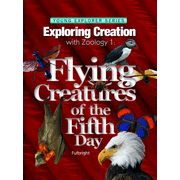
Flying Creatures of the Fifth Day: Exploring Creation with Zoology 1  -     
        By: Jeannie Fulbright
    
The science class is using the Apologia text about flying creatures, which is mainly birds and insects but includes bats and other airborne creatures as well.  They are doing lots of hands-on activities and creating a Charlotte Mason style notebook of all they are learning.


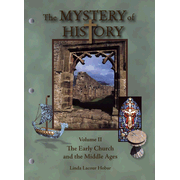
The Mystery Of History, Volume 2: The Early Church and  the Middle Ages  -     
        By: Linda Lacour Hobar
    
The history class is using Mystery of History Volume 2 by Linda Hobar. It covers the time period from the early church up through the Middle Ages. Each day they read a lesson, make note cards with the important facts, do an activity (such as mapping or a short report) and add a figure to their time line.


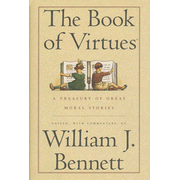
The Book of Virtues   -     
        By: William J. Bennett
    
I teach my daughter's English class, which is 5th-6th grades. I chose to integrate the literature and writing assignments with their history topics, so if they are studying about Genghis Khan in history, we'll read a legend about him for English. The easiest way to accomplish this is to use The Book of Virtues as our main literature resource. 


We are also reading through the book of Acts in the Bible and C.S. Lewis's The Lion, The Witch and theWardrobe. I have been writing my own study guide for that.  For the last class, I brought in some Turkish Delight candy since Edmund eats this while being lured by the evil White Witch in the third chapter.  The first two chapters featured the Professor's huge country mansion and the Faun's small cave, so I assigned the following for creative writing: “Imagine that you could design a dream house that reflects your own interests. It can be as large or as small as you want. Where will it be? What will it look like on the outside? Describe each room in your house. What will they be used for? What will they contain? Draw a floor plan if you would like.” and “Yesterday you wrote about a big house you would like to live in. Today, you are going to write about a small one. If you had an entire home to live in by yourself that was as small as Tumnus's cave room, what would it be like? Make a list of what would you need to live in your home and a few extra things that you would want. What are some practical ways you could “make do” in such a small space?” I know my students (6 girls and 1 boy) enjoying this project immensely and we had a lot of fun when they read their house descriptions in class. I mentioned that they might want to download the free version of the Sketchup 3-D drawing program to design their houses, and some of them have been doing that, too.  In the spring, we will also read the book The Door in the Wall by Marguerite DeAngeli.  Usually I would assign more novels, but since we have a lot of stories from The Book of Virtues and the co-op leaders asked me to focus more on writing this year (a current need), I limited it to just those two.

 
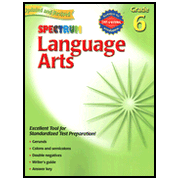
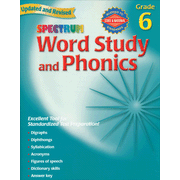
Spectrum Language Arts, 2007 Edition, Grade 6   - Spectrum Phonics, 2007 Edition, Grade 6   - Besides the reading and writing, they are also doing two workbooks from Spectrum: Language Arts 6 and Word Study and Phonics 6.  My classroom assistant, another mom in our co-op, has been helping a lot with the grammar lessons in the Language Arts workbook.  She is very enthusiastic about this, and has even set some grammar facts, such as the list of indefinite pronouns, to hymn tunes.  Speaking of that, we're also going to try to tuck in a little music sight reading skills along the way. Singing is a form of communication, isn't it?


In addition to her co-op classes, my daughter is doing some reading on her own. One of her older sisters convinced her to start Little Women by Louisa May Alcott, which has been a good pick for her.

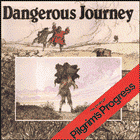
Dangerous JourneyMy 8th grade son is using the McDougal Littell Pre-Algebra text for math. For history, he and the other 7th-8th graders are doing A Beka America, Land I Love. Like many of the other 8th graders in co-op, he is taking Apologia Biology for high school credit, since that follows last year's General Science course pretty nicely. His English class is using the BJU Press Writing & Grammar workbook, as well as a variety of literature. Their first book is The Dangerous Journey, an adaptation of Pilgrim's Progress. They will also be reading The Witch of Blackbird Pond, The Light In The Forest, Sounder, and From the Mixed-up Files of Mrs. Basil E. Frankweiler.

 
My husband is responsible for helping my son with his math and science, as well as grading assignments for both of those classes. I am very grateful. He does this for our high school son's math and science, too.

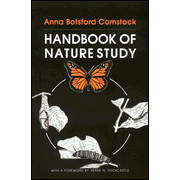
Handbook of Nature Study   -     
        By: Anna Botsford Comstock
    
In addition to his co-op classes, my son likes to draw, take pictures of nature (especially birds, especially after taking the same Apologia flying creatures class this his sister is in now), make videos, and read a wide variety of non-fiction. My sister sent a big box of books this week and he immediately claimed a biography of Thomas Edison, a drawing book, and Anna Botsford Comstock's massive Handbook of Nature Study, which was orginally published a century ago.

Our family also has a Fun Pass to Sea World, thanks to help from my mom.  If you pay for a single day ticket, they give you the rest of the year free!  That's a lot of marine science field trips.


So that's what we're doing for middle school this year!

Virginia Knowles


Wednesday, June 13, 2012

Preparing Our Children for the Storms of Life


Preparing Our Children for the Storms of Life
by Virginia Knowles
(excerpted from my archives)

The storms of life will come and go, but will your child be prepared or be blown away? In some ways, home schooling shelters children from many storms of life – appropriately so!  In other ways, it can prepare them to be even more effective in dealing with challenging and disappointing situations.  This process takes effort on the parents’ part as they try to discern the balance of sheltering and preparing.  There are many ways any parent can help prepare a child for weathering the storms of life.

Cultivate a sense that God is in control, no matter what happens. Show how faith, hope, and love can conquer depression, fear, and anger.  We don’t always understand what is happening, but we can trust a sovereign God.  In showing God’s providence and our need for perseverance, you can use Bible stories (such as Joseph, Ruth, or David), Bible verses (such as Psalm 43:5, James 1:2-4, Romans 5:3-5, Romans 8:26-39, 1 Peter 1:6-9, and Habakkuk 3:17-19), hymns and worship songs, and prayer.  Many children are disillusioned when they pray and God doesn’t answer like they want him to.  Explain that sometimes he answers yes, sometimes no, and sometimes wait.  Share stories from your own life when you asked God for something that would not have been good for you, and how you are glad you didn’t get your own way.  You can also model a wholesome response to trials in your own life.  Your children are always watching you! 

Equip your child with both skills and responsibility ahead of time.   Don’t coddle your children – challenge them!  If you make life too easy for them, they will never be strong enough to face the outside world. Stretch them appropriately in their academics and household chores, and don’t let them give up on an assignment just because they think it is too hard.  Press on!   Children who have learned to value responsibility and duty over comfort and convenience will have more inner strength to face challenges in life.  There are also specific skills you can teach that will help your child prevent or solve problems. Be sure to cover time management, money management, organization skills, household repair, etiquette, and communication, etc.  With younger children, play “What If?” games, asking what they could do if they got lost at the mall, or another child dared them to do something wrong.  An ounce of prevention is worth a pound of cure.  Teach Biblical peacemaking concepts.  Walk them through how to resolve interpersonal conflicts, which are usually either the cause or result of so many of life’s storms.  

Let your child “own” his trials.  You can comfort them and brainstorm with them, but don’t be quick to offer easy answers.  Make it a dialogue, where you are merely coaching them through solving their own problems.   Give plenty of time – don’t rush through this process!   Follow up later on to see how well they are coping with the aftermath, and if there is any bitterness or confusion. Teach your children to think ahead of time about the consequences of their choices.  “If I do this, then that could happen.” Let them suffer the natural consequences of their own poor behavior, since they will learn from that more than from a lecture.  Do not let them whine, sulk, or manipulate others.  Hold them responsible for their share of conflicts, rather than simply blaming the other party to salvage a child’s feelings.  If you see your child reacting to a frustration with bitterness, accusation or impatience, stop them and role play a calm, wholesome response. I no longer allow my children to yell, “THIS IS STUPID!”  Instead, they may say, “I don’t understand this.” [Note in 2012: I definitely think we're slipping in this area!]  And finally, encourage your child to look for a life lesson that God is trying to teach them through this lesson.  If they caused their own problem, they could learn to repent and prevent situations from happening like this again.  In a situation that was not the child’s fault, they can learn patience to endure, faith in God’s care, and compassion for others who are suffering.  Be sure to point out “evidences of grace” that you see in your child’s life because of this trial that has helped them to mature. 

In your home schooling time, be aware of teachable moments. Read plenty of heart-reaching books where the people face difficult circumstances.  Talk about what they did that was appropriate, and what they did that wasn’t.  Biographies, well-written fiction, and even history text books can be so vital!  The time periods of the early church persecutions, the Reformation, the American Revolution, slavery, Civil War, Holocaust, Civil Rights era, and others provide many examples you can use in teaching how to deal with adversity.   We also like the animated history videos produced by NEST (www.nestfamily.com), since they show the struggles that famous people have faced.  While studying science, point out instances in the natural world where “adversity” is necessary to produce the best results, such as precious metals being refined, gemstones being hacked out of the ground and chiseled into shape, muscles being exercised, tree roots growing deep for nourishment and anchoring, etc.  Math can be a major source of frustration.  However, it can model more general problem solving principles, such as staying calm in the knowledge that the problem is here to teach you something valuable, following any instructions, breaking it down into smaller parts, thinking through the different options, working carefully with keen attention to detail, asking for help when necessary, and checking to make sure the solution is reasonable.  See how even the academic aspects of home schooling can prepare your child for facing the storms of life?  What a blessing!

I hope that these ideas are as helpful to you as they have been to me over the years.  Of course, we’re still working on them, but with 10 children in the house, there are plenty of opportunities to practice!    

~*~*~*~

P.S. I wrote this many many years ago for my e-magazine, The Hope Chest, and later posted it on another (now defunct) blog in 2006.  I really need to go over this stuff again!  Yow!


Friday, March 30, 2012

How to Write a How To!


Dear friends,

This is an assignment I gave to my 7th-8th grade English students in our home school co-op several weeks ago.  They really seemed to enjoy this one!

Virginia


EXPOSITORY WRITING ASSIGNMENT
"HOW TO" INSTRUCTIONS

This week your assignment is to write about how to do something.   This writing skill comes in quite handy because giving people instructions is a regular part of real life.   Here are the steps to writing a great "how to."

1.      Choose a topic that is simple enough to be explained on a single page. It should be one that you already know enough about, or can research easily, to make it clear and interesting.  Here are some sample "how to" topics:

·       How to make a hot fudge sundae
·       How to organize your bedroom
·       How to pump up bicycle tires
·       How to play a favorite outside game
·       How to choose the best book to read

2.     Decide on a format for instructions. You can use bullets or numbers if this would make it easier to follow.  A recipe usually lists the ingredients first, and then the instructions.

3.     Consider using pictures to show each step and the finished product.  This often makes a real difference on how clear and interesting your instructions are.

4.     Remember the important parts of your instructions:

·       Your topic sentence will introduce what you are going to teach and might give a hint of why your audience would want to do it.   If necessary, you can use two or three sentences for this.
·       Your supporting detail sentences should show, in chronological order, the steps in the process, as well as what materials are needed.  There may be more than one sentence per step.  Be sure that your transitions between steps are clear.  Keep your steps in a consistent format.  For example, you might want to present each step in simple command form, and then elaborate more on it in another sentence.
·       Your concluding sentence should provide some final motivation to go try it.

5.     Check your draft to make sure you have included all of the important information.  Don't assume that your readers know what you know.  Also check to be sure you haven't put unnecessary, off-topic information into your paragraph since that would be distracting.

6.     Polish it all up for a terrific final draft!  You can ask a parent or friend for help in deciding if your instructions are clear and interesting.

I think you'll have fun writing your "how to" instructions.  I sure enjoyed writing these for you!  

Thursday, January 12, 2012

"Truth Never Dies" (A Poem)


Truth Never Dies
Author Unknown

Truth never dies.  The ages come and go.
  The mountains wear away, the stars retire.
Destruction lays earth’s mighty cities low;
   And empires, states and dynasties expire;
But caught and handed onward by the wise,
  Truth never dies.

Though unreceived and scoffed at through the years;
  Though made the butt of ridicule and jest;
Though held aloft for mockery and jeers,
  Denied by those of transient power possessed,
Insulted by the insolence of lies,
  Truth never dies.

It answers not.  It does not take offense,
  But with a mighty silence bides its time;
As some great cliff that braves the elements
  And lifts through all the storms its head sublime,
It ever stands, uplifted by the wise;
  And never dies.

As rests the Sphinx amid Egyptian sands;
  As looms on high the snowy peak and crest;
As firm and patient as Gibraltar stands,
  So truth, unwearied, waits the era blessed
When men shall turn to it with great surprise. 
  Truth never dies.

The Sphinx

Gibraltar

I gave this poem to my 7th-8th grade co-op English students in their homework handouts on the first week of class last August.  We read it line by line in class, talking about the concepts, unfamiliar words (such as transient, sublime, and insolence), repetition ("Truth never dies") and the rhyming pattern of each verse (ABABCC).  I frequently give them well-written classic poetry in their assignments.  It's good for the brain and the heart!

For more on how we incorporate poetry at all grade levels, read here: 

Poetry in Life and Education


Go read a poem with your kids!

Virginia Knowles


Sunday, August 14, 2011

God's Grace in the Midst of Middle School Misery

GOD'S GRACE IN THE MIDST OF MIDDLE SCHOOL MISERY
by Virginia Knowles

8th grade
San Carlos, California.  April 1977.  I had just announced to my classmates that our family was moving to Baltimore.  A red headed chick named Kathleen burst out, “Yay!  Now we won’t have to pick her for our teams in gym class anymore!”  I have laughed about that many times since then, but there was also still a sting from the constant and cruel peer rejection that I suffered for so many years.  I’m sure many of you can relate.   Middle school kids can still be vicious.   Maybe this happened to you or maybe you treated other kids like that.  Middle school misery is real.

Well, I was one of those middle school outcasts.  I dressed and acted weirdly.  I talked too much.  I played chess at lunch time in the school library with the other outcast nerds, or we hung out at the nerd bench in the playground.  I had one dear Christian friend named Donna, a Jewish friend named Teresa, a Mormon friend named Kathleen, and a Chinese friend named Anni.  We were social rejects -- and it hurt!  So where is God's grace in “Yay! She’s out of here and good riddance!”

As I reflected on this a few years ago, the amazing truth suddenly dawned on me: How kind the Lord was to rescue me up out of that place and give me a fresh start!   I had been recently saved but didn't have a church to go to.   
Anne and I at my going away party
In his sweet sovereignty, God moved me all the way across the country to Baltimore to plant me in a nurturing church where folks loved me and discipled me.  They didn’t care whether I could play sports or not!   A sweet girl named Anne, who sat next to me in chorus class in my new school, invited me to church.  Her parents faithfully drove out of their way two or three times a week to come pick me up.   By the time I moved away two years later, I had a whole bunch of great Christian friends, and I could hold my own much better among my peers at school.   Most importantly, I now had a solid foundation in Scripture, prayer, and missions.


My sister Barb and brother John, with me in the middle
I also see how kind God was to birth klutzy little me into a creative family that skipped sports, dumped the TV for six years, and put heavy emphasis on books, writing, art, and music.  Those creative pursuits all still serve me well as a home school mom.  


Another benefit I received from my own childhood experience is an increased sensitivity to the middle school students in the co-op English class that I teach.   Each week, using literature, writing, logical thinking skills, and other language arts topics, I seek to give them solid life lessons to chew on.  I personally think it is vital in learning to treat others with dignity. 

I can now see how the Lord has redeemed my middle school misery for his glory.  Instead of rejection, I now see his Tender Loving Care.   


~*~*~


Virginia's note: I wrote this story many years ago, and plan to share it with my 7th-8th grade English students in our Providence Home Educators co-op in conjunction with the story of Joseph in Genesis.  Even if your children are entirely schooled at home and not in a classroom, I would encourage you to talk to them about accepting others, being welcoming and friendly, not being self-righteous with those who are different from them, etc.  And as adults, we too, should do the same, not just as an example to our children, but because there are hurting people out there who need an authentic friend --- someone to listen and love and not "fix" them.


Related Posts with Thumbnails