Pages

Showing posts with label Creativity. Show all posts

Sunday, September 14, 2014

Add a Little Adventure to Your Home School


Add a Little Adventure
to Your Home School

Life isn't just a matter of fun and games, but a spoonful of sugar sure can help the medicine go down. We can help our children actually enjoy the process of doing their work rather than just tolerating it. In the process, they will learn their own lifetime techniques for making tasks interesting. 

Middle school kids are naturally inquisitive. This creates big demands as Mom and Dad are barraged with “how” and “why” questions at inopportune moments. Within reason, we should not squelch curiosity, but catapult it into self-motivated learning situations.  Here are some ways to enliven academic pursuits:

Hobbies: Hobbies can provide beautiful balance to a home education program. They offer brain-enriching opportunities to plan projects, select materials, follow patterns and instructions, develop skills, care for equipment and supplies, make useful items, and nurture creativity. You could spend tons of money on this (“I want a pony!”) but many activities are free or cheap. 

Imagination: Encourage your children to use their imaginations to ask “what if?”  Let them dream about what they would do with a million dollars or what new technology they want to invent. Even middle school kids can enjoy a well-stocked dress up box for making up their own skits and shooting videos.

Interests: Plan some of their school lessons around their own interests. At the beginning of one school year, I let each of my children choose one independent unit study topic to do for three weeks. One daughter chose dogs because she was passionate about them, even though we haven’t ever had one. She became a virtual “walking encyclopedia” about various breeds. She knew how big they are and the countries from which they originated. She constantly checked out library books about dogs, including titles on how to draw them. Her walls were covered with her sketches, original stories and collages of magazine pictures. For her birthday, I found the Dogs and Puppies Complete Identifier guide book featuring more than 170 breeds in full color photographs. As you can see, from this one interest, she learned reference skills, geography, math, literature, art, creative writing and alphabetization -- and she didn’t even know she was doing school work!   Later, she switched to other interests like music and British literature.

Literature: Include adventure stories in their literature selections, especially as they relate to a unit study. When we studied Australia, we read the first three books of Robert Elmer’s Adventures Down Under series, set in the 1800s. It didn't even seem like school time.

Seasons and themes: Plan art projects, literature, field trips, music, and cooking to enhance holidays, seasons and unit studies.  For example, at Christmastime you can plan an Advent Adventure unit by singing carols, baking cookies, making presents, and reading favorite Christmas poems and stories. For St. Patrick's Day, make green foods to eat, and read about the real St. Patrick.

Bookmaking and displays:  Let your children make an illustrated book or display to creatively summarize what they have learned about a topic. For tabletop projects, we might use three panel folding display board.

Creativity box: Fill an odds-and-ends box with spools, straws, craft sticks, cord, clothes pins, toilet paper tubes and other items for kids to make things of their own. Collect old small appliances for your young tinkerers to dismantle.     

Nature study: Go on nature walks and collect specimens to identify and observe. Are there any nature trails in your county? One of my sons, by age 11, was a nature lover and a talented photographer. He combined these two passions by taking pictures of birds and plants, then editing them on the computer and uploading them to his nature blog. He also recorded bird songs with our video camera. He extended this to academic studies by doing research on birds and their habitats, as well as making detailed pencil sketches. We equipped him by providing several high quality bird guides, including ones that have an audio component that plays bird calls for each page. The best thing we can do is give him plenty of time for this hobby!  This is a huge part of his science studies.

Field trips: Visit local sites such as a history museum, art museum, science center, wildlife refuge, botanical garden,  community theater, beach, etc. If you will be visiting a location often enough, consider getting an annual pass.

Clubs and Classes: Check out art and music instruction, social clubs, hobby clubs, drama groups, choruses, and other group opportunities.

Science experiments: Check out books from your library to find activities which are educational, entertaining, and fairly uncomplicated. Keep basic science exploration supplies on hand, such as magnifying glasses, magnets, and test tubes.

Gardening: Let them plant a garden. If you are a novice or have a black thumb, try buying mature plants instead of growing from seed.  This is also a time to build relationships with neighbors; if you see someone working outside and they have a great garden, ask for advice!  People are usually thrilled to share their expertise.

Pets: Get a class pet. Think through this decision carefully. With most pets, your commitment runs at least a few years. If your pet is unfriendly, your child may resent caring for it. If you choose a nocturnal animal such as a hamster, it might make noise at night and sleep through the day!  You can also choose temporary pets. Our kids keep a terrarium on the back porch ready to house lizards, frogs and other small critters they catch in the yard. They might keep them for a few hours or a few days and then let them go. I like this kind of pet best of all!  Our kids also loved keeping fish. They started out with small aquariums, learning a lot about different kinds and the care they need, and eventually worked up to a 50 gallon aquarium with convict cichlid fish in it. Some of the cichlids had hundreds of babies, which was especially fascinating to watch.

Games, puzzles and crafts: Try strategy and word games such as chess, Pente, Rummikub, Boggle, Scrabble, Twenty Questions, Concentration, etc. Let your child keep score to sharpen math skills, especially in Scrabble, where there is doubling and tripling. Find related games, puzzles, and crafts to supplement regular lessons. Teacher’s manuals and web sites sometimes include ideas for these, but you and your children can make up some of your own.

Group festivities: Participate in your support group’s science fair, history day, international festival, fine arts show, or other opportunities. If they don’t already offer these activities, why not volunteer to do it this year?

Friday, February 1, 2013

What Are These Foods? (Image & Imagination #4)


What are these?

Hint:
They are all from something edible...

Try looking at common objects in new ways,
in different forms.

Be attentive to odd things just as they appear.


With a silhouette.


Weird already...


Cropped to see just a part...

Or artfully arranged...


How can you use image and imagination in the kitchen?

Try it!

I took all of these pictures, many in the past few days.
The others are from posts on my other blogs, as linked below.

So what are they?

Train your eyes to see -- to be amused and amazed at God's creativity!

Life will be so much more interesting and inspired!

Virginia Knowles
www.ContinueWellHomeSchool.blogspot.com


Wednesday, September 19, 2012

Masterpieces from the Bible (Image & Imagination #2)

Last week I started a new blog series, Image & Imagination, to explore how to stimulate our children's curiosity with pictures

I like to integrate fine art and Biblical themes when I teach, whether it is in my own home or in our home school co-op English or history classes.

Our 5th and 6th graders have been studying the early church in history class and reading through the book of Acts in English class.  In class this week, I showed them several pieces from the huge volume of Great Bible Stories and Master Paintings by Owen S. Rachleff, which was a gift from my late father-in-law in our early home schooling years.  I wish we had more time to take a long look at them!  Maybe next week...  You can look up these paintings on-line, keeping in mind that there are variations in titles.  I have linked some of them here:


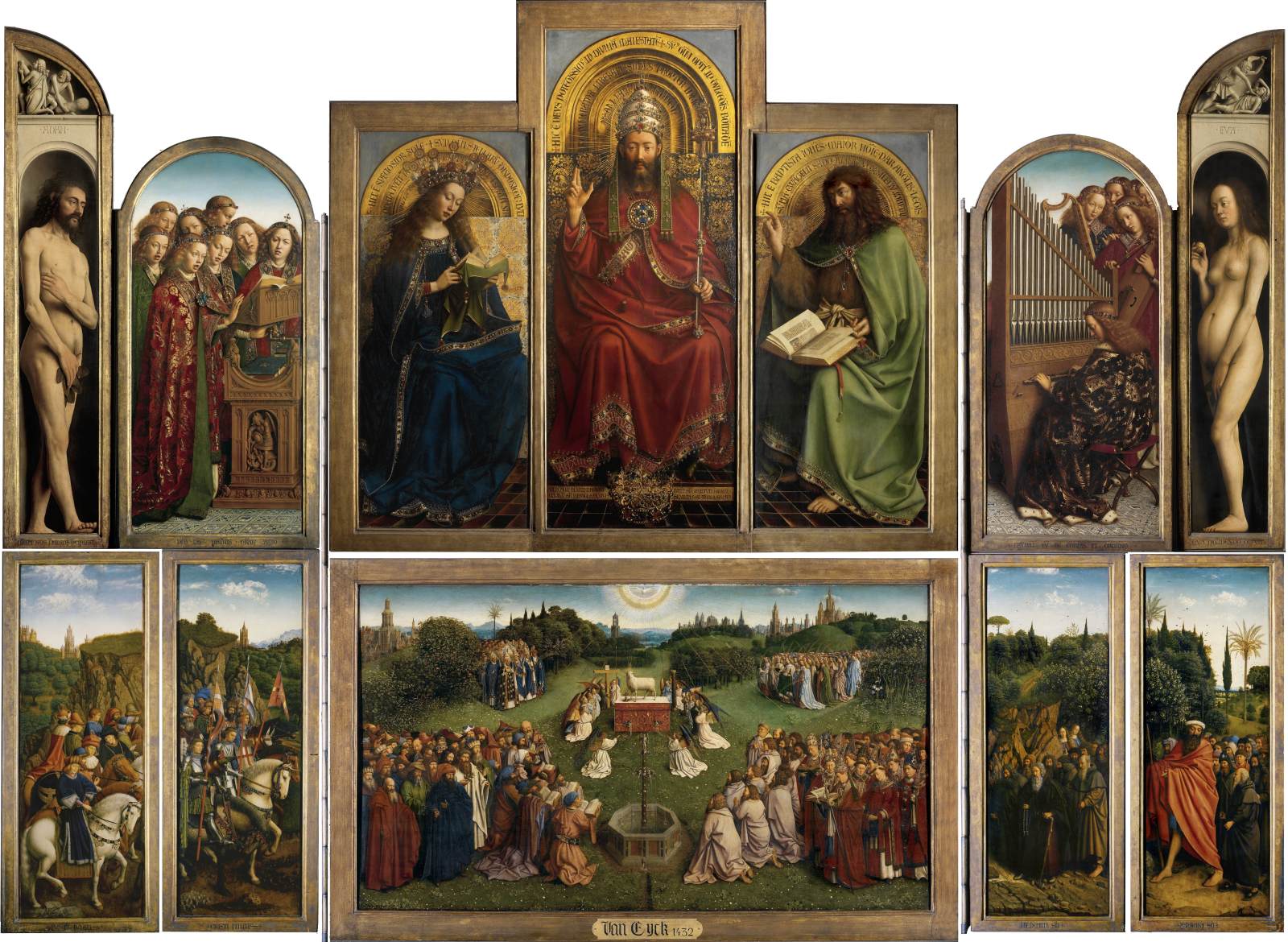
Another masterpiece that I've been enjoying lately is "The Adoration of the Lamb of God" by Flemish painter Jan Van Eyck.  This picture has graced the front of our church bulletin every week in this liturgical season after Pentecost.  I wonder what painting will come next?


The painting you see above is not even the full piece of art.  It is a portion of the lower center panel in a polyptych (multi-panel) piece.


You can find wonderful commentaries on masterpiece paintings on-line.  Here are two which are particularly helpful for this piece:


For example, within its lengthy description, the latter of these sites notes, "Thus the central panel of the lower tier portrays the saints symbolizing the eight Beatitudes gathered round the altar where the sacrifice of the Lamb is taking place, at the centre of the heavenly garden which has sprung from His blood."


I encourage you to look at the sites I linked and study this painting and others. On my class blog in previous years, I posted several lessons which include a lot of Biblical art along with associated writing and literature assignments. 

Virginia Knowles

www.ContinueWellHomeSchool.blogspot.com

Saturday, September 15, 2012

The Lion, the Witch and the Wardrobe Study Guide, Part 1 with Web Links

Friends,

 In our home school co-op, the 5th-6th English class that I teach is reading The Lion, the Witch and the Wardrobe from the Chronicles of Narnia series by C.S. Lewis.  We do about two chapters per week, and I am creating the study questions, writing assignments and activities as I go.  There are 17 chapters in the book, and so far I have finished up through chapter 8.  I'll post the other 9 chapters later on! (Edit to add - many years later, I never did!)

The study questions are a mix of simple recall and deeper reflection.  Occasionally, I refer to vocabulary words, grammar, punctuation, or literary devices.  Some of the writing assignments are geared for practical real life application, while others stimulate imagination and creativity.  If you have study questions or writing assignments to suggest, please add them in a comment!

At the bottom of this post, I have included several links to other on-line study guides for this book.  Some of them are suitable for older or younger children.  Quite the smorgasbord!  There is also a YouTube clip from the movie sound track.  You may want to watch the movie after reading the book and discuss how things are different or the same between them.


The Lion, The Witch and the Wardrobe
Study Questions and Writing Assignments
Part 1: Chapters 1-8

Chapter 1: Lucy Looks Into a Wardrobe

The main elements of a story are the characters, the setting (time and place), and the plot.

Characters

  1. List all of the characters mentioned in this chapter.
  2. Match the four children with these descriptions:

          ____________________ is sassy, grouchy and mocking.

          ____________________ is sentimental and nurturing.

          ____________________ is adventurous and intelligent leader.

          ____________________ is cautious but curious.

Settings

What is the historical time period? In 1940-1941, during World War 2, Nazi Germany bombed London and other British cities. Over 43,000 people died and 140,000 were injured. For their own safety, thousands children were sent to live in the country with relatives, friends, and even strangers. Author C.S. Lewis draws on his memories of hosting refugee children in his country home as he writes this book.
    3. List the three settings in this chapter.
    4. What are some of things that the children find in the rooms?
Writing Assignment

Imagine that you could design a dream house that reflects your own interests. It can be as large or as small as you want. Where will it be? What will it look like on the outside? Describe each room in your house. What will they be used for? What will they contain? 


Activity: Draw your dream house: what it looks like from the front, what one room looks like, a floor plan.  Download SketchUp for free and try designing a 3-D model of it.


Chapter 2: What Lucy Found There
  1. Tumnus, the Faun, asks Lucy if she is a Daughter of Eve? What does he mean by that? Why is Lucy confused?
  2. List the four different kinds of forest creatures who live in Narnia.
  3. What was Tumnus plotting when he lured Lucy into his cave and lulled her to sleep with food, stories, and flute playing?
  4. What could be the consequence if he did not carry through on his plan?
  5. What are three ways we can tell that Tumnus is remorseful and repentant?
Writing Assignment

Yesterday you wrote about a big house you would like to live in. Today, you are going to write about a small one. If you had an entire home to live in by yourself that was as small as Tumnus's cave room, what would it be like? Make a list of what would you need to live in your home and a few extra things that you would want. What are some practical ways you could “make do” in such a small space?

Activity:

Plan to invite a friend over for a simple meal or dessert.  What will you serve? What activities will you do?  Think about what you can do to make your guest feel welcome and comfortable.

Chapter 3: Edmund and the Wardrobe
  1. Lucy thinks she has been gone for “hours and hours” but her brothers and sister say they saw her only a few minutes ago. Why?
  2. What do her brothers and sister think and do about what she has told them?
  3. When Edmund apologizes to Lucy for not believing her, is he showing true remorse? How do we know?
  4. A “sledge” is another word for sleigh, a vehicle that travels over the snow on runners. What kind of animals are pulling the sleigh, and who is driving it?
Creative Assignment

Draw a picture of the White Witch, also known as the Queen of Narnia. Or create your own villain or superhero and provide captions to describe what they can do.


Chapter 4: Turkish Delight
  1. How are the White Witch's inward attitudes different from her outer actions? What do we call this?
  2. How did the food and drink appear?
  3. Why did Edmund want more and more Turkish Delight? How did this affect his ability to think about what he was doing and saying?
  4. After flattering him by telling him how wonderful he is (when he actually isn't), what does the White Witch promise Edmund, and what must he do to get what is promised?
  5. Why does the White Witch want Edmund to keep it a secret?
Writing Assignment

Write a paragraph about something that a person your age might want to do or have more than anything. Tell why this might become addictive (something they can't seem to give up, even if they try) and what the consequences might be if they continue to give in to this strong desire. How could they overcome it?

Activity:

Buy some Turkish Delight (which you might find at a Middle Eastern grocery store) and serve with a hot drink.

Chapter 5: Back on This Side of the Door
  1. Go on Edmund; tell them all about it.” A semi-colon is used to separate sections of the sentence. A semi-colon is stronger than a comma, but not as strong as a period. Write your own sentence with a semi-colon.
  2. Edmund is acting really nasty in this chapter. What are some synonyms (similar meaning words) of nasty that are used in this chapter to describe Edmund and his actions? (P.S. A word to compare how nasty something is is nastier and someone who is the most nasty is called nastiest. One sentence also says that he gave a little snigger, which is a short mocking laugh.
  3. Why did the Professor suggest that Lucy might actually be telling the truth? Give at least three reasons.
  4. The Professor also suggests only three possibilities about what Lucy is aying: that she is lying, that she is mad, or that she is telling the truth. That may be true in this situation, but in general life, there is actually a fourth possibility. Someone can be sincerely mistaken after being given misleading, confusing, or false information. They may not be accurate, but they are not intentionally deceiving anyone or being crazy. Tell of a time when this happened to you or someone you know.
  5. Why did all four children end up going into the wardrobe in this chapter?
Writing Assignment

The Professor suggests that Lucy is more credible (believable) than Edmund. If you want people to think that you are credible, what kind of character and actions do you need to have? Name a fairy tale or other commonly known story where someone lacked credibility? Why? What was the result?


Chapter 6: Into the Forest
  1. What did the children discover at the Faun's home?
  2. What is the “Queen's” first name?
  3. What is Lucy's response when Susan says they should go home? What does this say about her character?
  4. How did the children know which way to go to look for Tumnus?
Writing Assignment

In one paragraph, describe something that you have had to do that required risk or extra effort. What was the result?


Chapter 7: A Day with the Beavers
  1. Anthropomorphism is when an animal, plant, or deity is given human characteristics, behavior and language. Anthro means human and morph means change. List all of the animals and plants that act like humans in this chapter, and tell what they can do. Be as complete and as specific as you can, thinking especially of things that humans can do that animals and plants can't.
  2. List your three favorite animal characters that act like humans in other stories. Each one should be from a different story or series. (Disney movies are a good source for this!)
  3. Body language is an important part of communication, sometimes even more important than the actual words that you say. What did Mr. Beaver communicate by his gestures?
  4. What object did Mr. Beaver give to the four children to gain their trust?
  5. 2 Corinthians 2:14-16a says, But thanks be to God, who always leads us in triumphal procession in Christ and through us spreads everywhere the fragrance of the knowledge of him. For we are to God the aroma of Christ among those who are being saved and those who are perishing. To the one we are the smell of death; to the other, the fragrance of life.” Thinking about those verses, why do you think each of the children subconsciously reacted in a different way to the mention of Aslan's name? You may have to ponder this question a little bit, or ask a parent for help.
  6. What do you think Edmund was thinking when he saw the two little hills?
  7. List five things that the children ate or drank at the home of Mr. and Mrs. Beaver. Which of these would you most enjoy?
Writing Assignment:

The author compares the children's reaction to the mention of Alsan's name to being in the middle of a dream and not understanding the details but somehow still grasping the significance of it. Write about an interesting, funny, or confusing dream or a nightmare that you remember. Do you think there was any meaning to it? For example, had you been thinking or wishing or worrying about something, and then dreamed about it?

Activity:

Demonstrate body language with your gestures and facial expressions to show that you are angry, happy, sad, excited, confused, or that you want to be left alone.  Or play Charades!


Chapter 8: What Happened After Dinner
  1. What does Mr. Beaver think happened to Tumnus the Faun, and what does he say is the only hope for rescuing him?
  2. Copy the poem that Mr. Beaver quotes about Aslan.
  3. How do Mrs. and Mr. Beaver each reply when Lucy asks if Aslan is safe?
  4. Where will the children meet Aslan?
  5. What is the prophecy about the Sons of Adam and the Daughters of Eve?
  6. Why did Mr. Beaver think that Edmund had betrayed them to the White Witch?
  7. What is the most immediate danger at the end of the chapter?
Writing Assignment:

Write a factual paragraph about beavers. Include an introduction sentence, one sentence each about what beavers look like, where they live, and what they eat, and then a concluding sentence.  

Activity:

Play the Statues game -- all you need is four players and some space to move around!

Links to other study guides for The Lion, the Witch and the Wardrobe:

Ripstick or Rat Face?


It's a rip stick, right?
Left by a child on the 
concrete patio at the play ground, 
it's ready to roll.

Or is it El Raton, the ominous rat 
with beady eyes and a furled brow?


In coming posts, lets talk about Image and Imagination.  Let's explore how to stimulate our children's curiosity with pictures, whether it is photos like the one above, or masterpiece art, or advertisements, or even random doodles. I think we can get some good writing prompts going!  I'd love to hear your ideas!


 P52 Photo Project  this week's theme "Hobbies"
P52 with Kent Weakley

Yes, I confess!  I posted two pictures for P52 this week!  You can find the other at on my www.comewearymoms.blogspot.com at On Clouds, Hands, Oysters and Messy Humanity. 

Monday, July 19, 2010

Creator, Creation & Creativity

Creator, Creation & Creativity
An excerpt from The Real Life Home School Mom: It's a Life in Revision

As home school moms, we long to fill our children’s hearts and minds with good things! We are not just talking about behavioral rules or academic skills, but a thirst for beauty. We are right to focus on the cross and salvation as the foundation of our faith, but we also need to reverence the Lord as our Awesome Creator. Think back to Genesis about how our Lord marvelously called our world into existence. Paradise! Beauty! Purpose in life! Oh, how sin marred this ideal, but creation still points us to our Creator. In fact, Romans 1:18-20 says: “For the wrath of God is revealed from heaven against all ungodliness and unrighteousness of men, who by their unrighteousness suppress the truth. For what can be known about God is plain to them, because God has shown it to them. For his invisible attributes, namely, his eternal power and divine nature, have been clearly perceived, ever since the creation of the world, in the things that have been made.”

I think that part of introducing our children to spiritual things, to the realm of a Gracious God in their lives, begins with an appreciation for creation. We should give our children ample time to enjoy the splendors and the intricacies of the natural world. They should gain a sense of divine awe for the masterful design of geographical formations, plants, and animals. This can inspire us to worship the Lord! The same God who created all this created me, too! We didn’t evolve from pond slime. We were designed by an all-knowing all-powerful God who has a plan for our individual lives. There are myriad excellent resources to teach our children about creation versus evolution. The Incredible Creatures that Defy Evolution DVDs are a great example of this.  As home school families, let’s take full advantage of our right and privilege to use them.

I recently came across a book which expands on children, nature, creativity, imagination, a sense of wonder and mystery, the arts, and the heart far beyond whatever I could write here. Be sure to get a copy of Romancing Your Child’s Heart by Monte Swan. This is a masterful book on parenting, a must-read highly recommended by folks like Tedd Tripp (author of Shepherding a Child’s Heart), Dennis Rainey (Family Life Today), and Wade and Jessica Hulcy (authors of the KONOS curriculum). I was captivated from the start by Monte’s description of his own Wisconsin childhood, and parents who nurtured his love of nature and of creative tinkering, even though he struggled with traditional learning. The aimed for the heart – and they got it! Monte writes: “As we smell a wildflower in the springtime, watch a blazing sunset over the desert, or witness a thunderstorm on a sultry summer afternoon, beauty and drama capture our hearts. Is the wonder we feel the response He hoped for as He created these things? I'm confident that creation reveals another aspect of romance in God's heart. He's the first Quilter of prairies, the primer Painter of autumn colors, the archetypical Sculptor of the mountains, the master Composer of the whippoorwill's song, and the original Poet of grace and truth. And He has imprinted His creative image in human hearts. Burning curiosity, wonder at mystery, and the delight at finding a solution that makes order visible -- all these accompany creativity, giving us our fullest happiness and deepest satisfaction on earth."

Let’s go beyond nature study to more human endeavors. Our creative God, who made us in his image as creative beings, often reveals himself through the “common graces” of literature, art, music, and nature study. Charlotte Mason, the esteemed turn-of-the-century British educator who wrote much about home schooling, always urged parents to make the most of these, rather than merely dull dry paperwork. She envisioned children growing up wholesomely in the spiritual, emotional, mental, and physical realms of life. That’s what we want: true beauty, a keen aesthetic sense that so fills the soul that there is no room for the garbage our culture dishes up so liberally. The beauty I am talking about is not just “pretty stuff” for the eyes and ears. It is not devoid of pain and suffering. It is what transforms the soul toward the inner beauty of kindness and compassion – and that will mean exposure to the pathos of human existence. Our literature choices need to carefully reflect real life at the heart level. French archbishop Francis Fenelon wrote in 1687:

“Children filled with thoughts of their romantic heroes, become astonished when they look around in real life, and cannot discover a single person throughout the world bearing resemblance with their ideal hero. They would wish to live like those princes and princesses who are always charming, always adored, always above every care. What a disgust for them to descend from a hero and heroine, to the low detail and drudgery of taking care of a family. Children should be influenced by books that vividly portray life in all its trials and victories. Divine providence should echo throughout its pages. Characters who suffer wrongfully in a righteous manner, and display humble dispositions, will lay a secure foundation for the time when childhood may be stolen away; perhaps through the death of a loved one, sickness, or calamity. Children need informed instruction, and models of heroes and heroines of righteousness to fill their reserves for such a time. In literature as well as in history, God who doeth all things well, must be seen through the filter of His divine love and tender care of His children and as an avenger of all who harden their neck.”

Literature, art, music, nature study – these are so vital to “ignite the delight” in a child’s education! But they must be worthy! Philippians 4:8 tells us, “Finally, brothers, whatever is true, whatever is honorable, whatever is just, whatever is pure, whatever is lovely, whatever is commendable, if there is any excellence, if there is anything worthy of praise, think about these things.”

What is the learning atmosphere in our homes? Are they places where great books are read to one another in the evening (or at any other time), where lullabies and hymns are sung, where fine art books are contentedly browsed through on the couch, or where an older sister thinks to put on classical music so a tiny brother and sister can grow up with a bit of culture? We can have it if we choose it. Even if we don’t own all the resources we would like, we can always go to the library, or take a field trip to an art museum or a free concert in the community.

Beyond enjoying the creativity of other people, our hearts are nurtured when we create beauty, too! Art is not just another school subject. In whatever form it takes, it is a way of touching the heart, of being who God created us to be. We can affirm our children in their fledgling efforts at creativity. Each child has different talents and interests, but each one can find a niche or two. Whether it is a pennywhistle performance, a colored pencil drawing, a pattern block design, a piano minuet, a zany impromptu skit, a rollicking rhyme, a fragrant flower garden, or a tasty ethnic meal – may our lives be enriched by the abundant fruits of their creativity! We don’t expect perfection because we learn and improve as we go. We don’t want to squelch the desire with undue criticism. Our family once visited an Eric Carle exhibit at our local art museum. From an information panel on the wall, we learned that he was inspired in his vibrant artistry by a kindergarten teacher whose encouragement carried him through the rest of his dull years of education. How much will our words of affirmation mean to our children, for whom we will be primary teacher for so many years? Let’s aim for the heart with the arts!

If you still think that the creative arts are optional, ponder for a moment how they can be used for God’s glory within the church. Our children have sung in choirs and on the church worship team, acted in church musicals, painted sets and sewed costumes for Christmas productions, face painted for community outreaches, mimed on mission trips, helped out with kids’ crafts during a Mom’s Brunch and much more. Our church also has several talented young dancers who bless us during holiday services, musicals, and youth outreaches. I see so much hope for the future of the church knowing these young people are using their creative energies – in whatever form -- to minister to others. Think also of how dependent our culture is on the arts to communicate messages about life. If we want to be able to draw people to the Savior, we are going to have to raise up a generation skilled in relaying the Good News through the most effective, heart-reaching means. Let’s get them hooked on honoring God with their talents while they are young! This starts with giving them high quality examples to emulate in the books they read, the music they listen to, the art they look at, the movies they watch, and the people they meet. Choose well – you are laying a foundation for life.
Related Posts with Thumbnails